

Some measurements are funny little things. They sound perfectly normal until someone asks you to actually picture them. You hear 20 feet, nod your head like, “Yep, I know that,” then suddenly realize your brain has produced… absolutely nothing. It happends more often than people admit.
I had that exact moment while helping a neighbor measure space for a backyard shed. He asked, “Do you think twenty feet is enough?” I stretched my arms out like that would somehow solve geometry. Spoiler it didn’t. We grabbed a tape measure, laughed at ourselves a bit, and realized 20 feet was much longer than we’d imagined.
That’s why having a real-world comparison makes such a difference. Instead of relying on numbers alone, you connect a measurement to things you already recognize every day. Whether you’re planning a garden, checking a parking space, estimating room dimensions, or simply satisfying your curiosity, learning how long is 20 feet becomes much easier when you compare it with familiar objects.
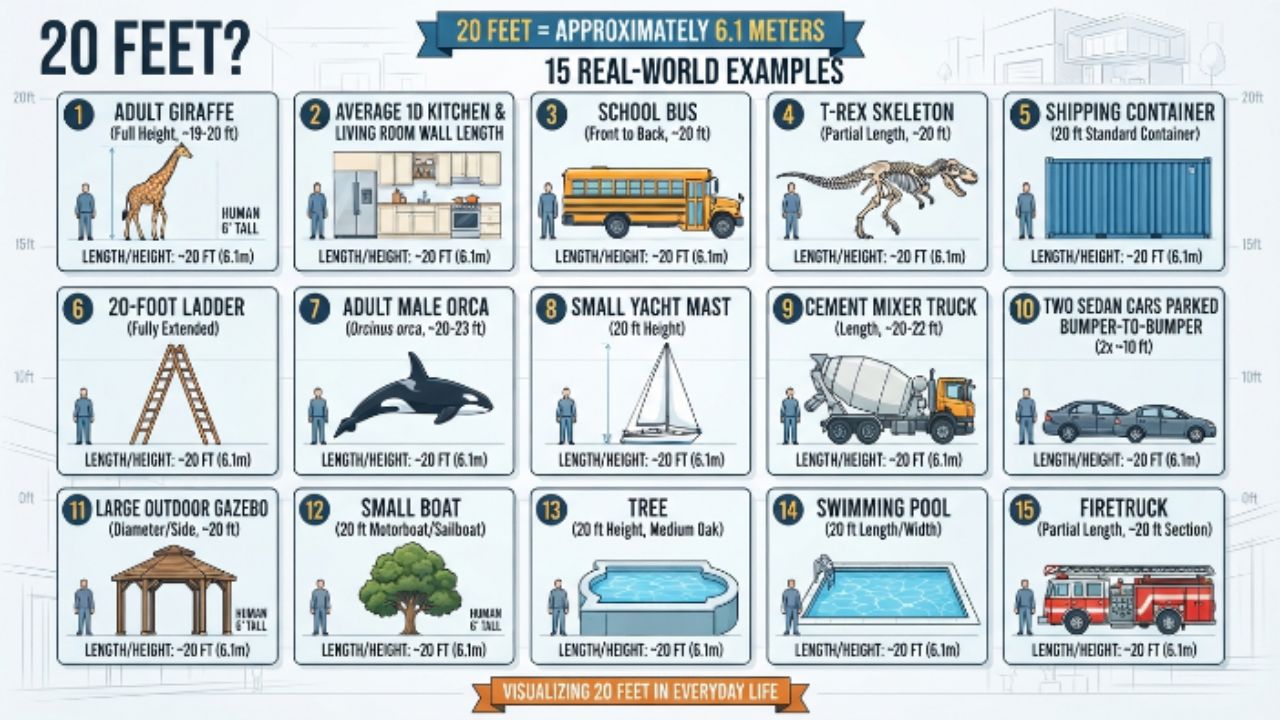
In this visual measurement guide, you’ll discover fifteen practical examples that make 20 feet visualized in a way your mind actually remembers. Along the way, you’ll also learn useful measurement conversions, simple estimation tricks, and where this 20-foot measurement commonly appears in everyday life and professional industries.
| 20-Foot Comparison | Approximate Size | Why It’s Useful |
|---|---|---|
| Standard shipping container | 20 ft (6.1 m) | Exact 20-foot reference |
| Full-size pickup truck | 19–21 ft | Easy everyday comparison |
| Mobile food truck | Around 20 ft | Common commercial vehicle |
| Extension ladder | 20 ft | Useful height reference |
| Residential flagpole | Around 20 ft tall | Visual vertical comparison |
| Two-story house | About 20–25 ft tall | Helps estimate building height |
| Full-grown giraffe | Up to 20 ft tall | Memorable natural comparison |
| 8 average walking steps | About 20 ft | Estimate without tools |
| Two parking spaces | Around 18–20 ft wide | Quick outdoor reference |
| Small commercial storefront | About 20 ft wide | Retail size comparison |
| Tennis court (partial width) | About 20 ft | Sports-related reference |
| Basketball court (partial width) | 20 ft section | Easy court visualization |
| Pontoon boat | Around 20 ft long | Popular recreational boat |
| Garden walkway | About 20 ft | Backyard planning reference |
| Measuring tape / Laser distance meter | Measures 20 ft accurately | Best for precise measurements |
How Long Is 20 Feet?
Before looking at real-life comparisons, it helps to understand the basic numbers behind this linear measurement.
- 20 feet = 240 inches
- 20 feet = 6.1 meters
- 20 feet = 6.67 yards
- Around 8 steps, depending on your Average step length
- Approximately the height of a two-story residential building
Knowing these conversions improves measurement accuracy, especially when switching between metric and imperial systems.
If someone asks what is 20 feet, think of it as a moderate distance that’s large enough to fit a vehicle, a shipping container, or several adults lying head to toe. It isn’t enormous, yet it’s far from small either. That’s what makes length visualization so useful.
Why Is It Helpful to Visualize 20 Feet?
Numbers by themselves don’t always stick. Your brain usually remembers pictures better than measurements.
Imagine someone tells you a playground climbing structure is twenty feet long. Unless you’ve built playgrounds before, that number probably floats around without much meaning. But if they say it’s roughly the same length as a standard shipping container, suddenly your mind has a clear image.
That’s exactly what measurement visualization is all about. It improves spatial awareness, strengthens scale perception, and gives you a reliable measurement reference whenever you need to estimate distance without reaching for a measuring tape.
Professionals like Architects, Surveyors, Construction professionals, Landscape architects, Urban planners, and Traffic engineers rely on these mental references every day because quick visual estimates often save valuable time before precise measurements are taken.
1. A Standard Shipping Container
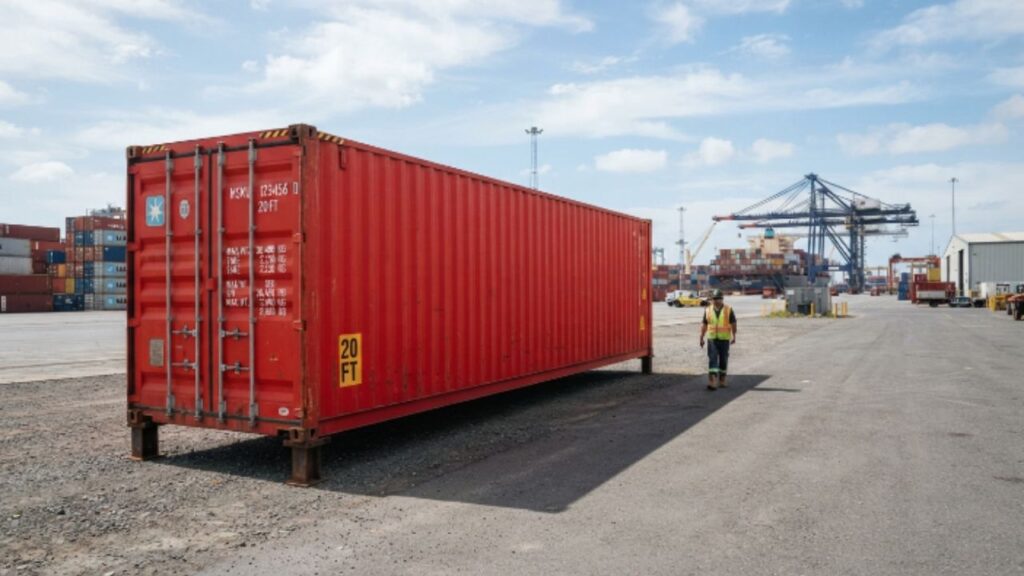
Perhaps the easiest answer to how big is 20 feet is a standard Shipping container.
A common Standard shipping container measures almost exactly twenty feet in length. These containers move products across oceans, railways, and highways every single day as part of the global Logistics network.
Whenever you see one on a cargo ship, freight train, or truck, you’re looking at one of the best real-world examples of 20 feet.
The size wasn’t chosen randomly either. It offers excellent Cargo capacity while remaining practical for Freight transport, Parcel distribution, and easy loading at Dock facilities.
If you’ve ever parked beside one, you’ve already seen 20 feet without realizing it.
2. A Full-Size Pickup Truck
Another excellent object comparison is a modern Full-size pickup truck.
Many heavy-duty models stretch very close to twenty feet from bumper to bumper. Some versions are just under, while others extend slightly beyond depending on the cab style and bed length.
This makes 20 feet compared to a truck one of the easiest visual references because pickup trucks are everywhere.
The next time one is parked nearby, imagine laying another adult beside it you’ll quickly understand the overall Length, Dimension, and Scale involved.
3. A Mobile Food Truck
Food festivals always make me smile a bit. Not just because of the snacks, honestly, but because those colorful trucks quietly teach measurements.
Most Mobile food truck designs are around twenty feet long. Inside that relatively compact space you’ll often find cooking equipment, refrigerators, storage cabinets, sinks, preparation counters, and enough room for several people to work together.
It’s kind of amazing, really.
These vehicles demonstrate how careful Space planning and smart Structural design allow businesses to fit an entire commercial kitchen inside a 20-foot measurement.
4. An Extension Ladder
Large Extension ladder models often extend close to twenty feet when fully opened.
Roof inspectors, painters, electricians, and Roofing crews regularly depend on ladders this size to reach upper floors safely.
Of course, Construction safety matters far more than simply reaching the height. Proper ladder angles, stable ground, and correct Safety clearance all play an important role before anyone climbs.
For many Builders and Homeowners, a twenty-foot ladder is a familiar sight during Home improvement projects.
5. A Residential Flagpole
Many homes, schools, community centers, and public buildings display flags on poles measuring approximately twenty feet high.
Standing beneath one gives a surprisingly accurate impression of Height and overall Proportion.
Unlike horizontal examples, a flagpole helps you understand 20 feet vertically. Looking upward often makes the measurement feel taller than when the same length is placed flat across the ground. Funny how our brains does that.
Because of this, Residential flagpole height is often used as a simple Visual reference when discussing outdoor measurements.
6. Nearly the Height of a Two-Story House
One of the easiest ways to answer what does 20 feet look like is to imagine a typical Two-story house.
While every building differs, many Residential homes stand somewhere around twenty feet from ground level to the Roofline.
This comparison is especially useful for people planning Residential construction, checking Building codes, or estimating Roofline structure dimensions before beginning renovation work.
Even experienced Contractors frequently make quick visual estimates before confirming exact Construction measurements with professional tools.
7. A Giraffe Standing Tall

Nature gives us some incredible measuring sticks.
A mature Full-grown giraffe can reach approximately twenty feet in height, making it one of the tallest land animals on Earth.
Seeing a giraffe at a zoo offers an unforgettable Real-world visualization of this measurement. You suddenly realize just how impressive twenty feet really is.
Kids often remember this comparison better than any ruler because it connects Measurement education with something exciting instead of numbers alone.
8. About Eight Average Walking Steps
Sometimes you don’t have a ruler, laser meter, or measuring tape nearby.
That’s perfectly okay.
An adult usually covers around 20 feet in roughly 8 steps, depending on their Average step length. Everyone walks a little differently, so this isn’t perfectly exact, but it’s surprisingly useful for quick Distance estimation.
Many experienced workers on Construction sites, Landscape architecture projects, and even sports coaches use pacing as a quick Mental shortcut before taking precise measurements.
It isn’t a replacement for professional equipment, yet for everyday estimating, it’s honestly much better than guessing randomly.
By combining everyday pacing with familiar objects like pickup trucks, shipping containers, and houses, you’ll gradually build strong Spatial measurement skills that make Visual estimation feel almost effortless.
9. The Width of Two Standard Parking Spaces
The next time you’re standing in a parking lot, take a look around before rushing off. There’s a good chance you’re already staring at a pretty handy measurement reference.
A single parking space is commonly around 9 to 10 feet wide. Put two parking spaces side by side, and you’ll have very close to 20 feet. It’s not exact everywhere—cities and shopping centers follow slightly different standards but it’s close enough for a reliable size comparison.
This is why Traffic engineers, Urban planners, and Construction professionals often think in parking-space dimensions when planning Public spaces, Infrastructure, and commercial developments.
10. The Width of a Small Commercial Storefront
Walk down a neighborhood shopping street and you’ll notice many small businesses occupy storefronts that are roughly twenty feet wide.
A compact coffee shop, boutique, or repair store often has a Commercial storefront measuring close to this distance. Even the Commercial awning above the entrance may stretch nearly the same length.
This example helps people planning renovations, estimating retail spaces, or visualizing Commercial building dimensions. Suddenly, how far is 20 feet isn’t just a number—it’s the width of a business you probably visit every week.
11. One Side of a Tennis Court
Sports facilities are full of measurements hiding in plain sight.
A regulation Tennis court is 27 feet wide for singles play, meaning 20 feet covers most of that width. If you’ve ever watched a match from the sidelines, imagine trimming just a few feet from one side, and you’re almost there.
Because court layouts follow carefully defined Court dimensions, coaches and facility designers often use them as dependable real-life measurements.
It’s one of those comparisons that quietly sticks in your memory after you’ve seen it once.
12. Most of the Width of a Basketball Court
A standard Basketball court measures 50 feet wide, so 20 feet is about forty percent of the court’s total width.
Picture standing on one sideline and walking toward the center. Before you even reach halfway, you’ve already covered about twenty feet.
This comparison is especially useful for schools, Sports facilities, and Recreational spaces where people frequently estimate distances without stopping to measure everything precisely.
Funny enough, basketball courts kinda train your eyes without you even realizing it.
13. A Small Pontoon Boat
If you’ve spent time near a lake, you’ve almost certainly seen a Pontoon boat measuring around twenty feet long.
These boats balance comfort with practicality. Families use them for fishing, relaxing, and short cruises because they provide generous seating while remaining easy to transport and dock.
For Marine designers, selecting the proper boat size involves balancing Length, weight, passenger capacity, and stability. A twenty-foot pontoon has become one of the most popular choices because it offers plenty of room without becoming difficult to handle.
It’s a surprisingly memorable answer to how long is 20 feet in real life.
14. A Large Walkway or Garden Path
Many residential gardens and public parks include a Walkway that’s approximately twenty feet long between two points.
Imagine leaving your patio and walking to a flower bed or gazebo. That short stroll may already cover 20 ft.
Landscape projects frequently rely on this measurement when planning Landscape architecture, outdoor seating, decorative pathways, and backyard layouts.
For Homeowners, visualizing a twenty-foot path makes future landscaping projects feel much less intimidating. Numbers stop being abstract and become something you can actually picture.
15. Measured with Professional Surveying Equipment
Sometimes the best comparison isn’t another object at all it’s the tools professionals trust.
A quality Measuring tape easily measures 240 inches, while a Laser distance meter provides quick digital readings over much greater distances. On large developments, Surveyors often use a Total station to achieve remarkable Measurement accuracy during Construction planning, Property measurements, Civil engineering, and Surveying projects.
These tools ensure every Dimension is correct before foundations are poured or buildings begin to rise.
Even though technology has become incredibly advanced, experienced professionals still develop excellent Distance estimation skills. They often make a visual guess first, then confirm it with precision equipment. It’s a nice reminder that experience and tools usually work best together.
Easy Ways to Estimate 20 Feet Without a Tape Measure
There are plenty of situations where you don’t have measuring equipment nearby. Maybe you’re planning furniture placement, marking out a garden, or checking whether a trailer will fit beside a garage.
Here are some practical ways to estimate 20 feet:
- Walk about 8 steps using your normal stride.
- Imagine the length of a Full-size pickup truck.
- Picture a Standard shipping container.
- Compare it to the height of a Two-story house.
- Use two standard parking spaces placed side by side.
- Think of a twenty-foot Extension ladder.
- Visualize a tall Residential flagpole.
These common measurement references won’t replace exact instruments, but they’re excellent for quick distance estimation and improving your everyday Spatial awareness.
Where Is a 20-Foot Measurement Commonly Used?

You might be surprised by how often this measurement appears in everyday life and professional work.
Construction and Home Improvement
In Residential construction, builders regularly work with twenty-foot sections when planning framing, Floor joists, roofing layouts, and outdoor structures.
Understanding Construction measurements helps reduce mistakes, improve efficiency, and ensure compliance with Building codes.
Architecture and Urban Planning
Architects, Urban planners, and Landscape architects constantly think about proportions rather than isolated numbers.
Whether designing sidewalks, plazas, green spaces, or residential lots, having a strong sense of Scale, Relative size, and Dimensional planning leads to better designs that feel comfortable for people.
Shipping and Logistics
The logistics world practically revolves around standardized dimensions.
The famous 20-foot shipping container forms the backbone of modern Global shipping, Freight transport, Cargo containers, and international trade.
Its standardized size allows smooth movement between Ships, Trucks, Trains, warehouses, and Loading docks, making worldwide transportation far more efficient.
Sports and Recreation
From Playgrounds to courts and swimming facilities, measurements determine how safe and enjoyable recreational spaces become.
Whether planning a Walking path, a climbing structure, or an athletic facility, accurate sizing creates consistency and improves user experience.
Why Learning to Visualize Measurements Matters
Being able to Visualize measurements is more valuable than many people realize.
Instead of memorizing numbers, you develop an instinct for space. That skill becomes useful while buying furniture, planning a renovation, arranging a backyard, choosing a storage unit, or even parking a vehicle.
Good Measurement visualization also strengthens Visual learning, making everyday planning faster and reducing costly mistakes.
After enough practice, your brain naturally builds a library of familiar references. You stop asking, “How long is twenty feet?” and begin saying, “Oh that’s about the size of a shipping container.”
That’s a much easier way to think.
20 ft Visualized
20 ft visualized is easier to understand when you compare it to everyday objects. Imagine the length of a standard shipping container, a full-size pickup truck, or about 8 average walking steps to quickly picture what 20 feet looks like in real life.
Frequently Asked Questions
How long is 20 feet in meters?
20 feet in meters equals approximately 6.1 meters.
How long is 20 feet in inches?
There are 12 inches in one foot, so 20 feet in inches equals 240 inches.
How long is 20 feet in yards?
Since three feet equal one yard, 20 feet in yards equals approximately 6.67 yards.
What does 20 feet look like?
A standard shipping container, a full-size pickup truck, a mature giraffe, or about eight walking steps all provide excellent visual comparisons.
How can I estimate 20 feet without tools?
The easiest method is pacing about 8 average steps or comparing the distance with familiar objects like a pickup truck, parking spaces, or a residential flagpole.
Read This Blog:https://mynoval.com/how-long-is-3-feet/
Final Thoughts
Understanding how long is 20 feet becomes much simpler once you connect it with the world around you. Instead of thinking only about numbers like 240 inches, 6.1 meters, or 6.67 yards, you begin seeing familiar landmarks a shipping container waiting at a loading dock, a full-size pickup truck parked outside a grocery store, a two-story home in your neighborhood, or even a graceful giraffe stretching toward the trees.
These real-world examples of 20 feet create lasting mental images that improve Length visualization, Distance estimation, and overall Measurement education. Whether you’re working on Home improvement, Construction planning, Transportation planning, landscaping, or simply satisfying your curiosity, having a dependable Visual comparison guide makes everyday decisions much easier.
The next time someone asks, “How big is 20 feet?” or “What does 20 feet look like?”, you’ll have more than one answer. You’ll have fifteen memorable comparisons that transform an abstract number into something you can picture instantly.
Do you have another everyday object that reminds you of 20 feet? Share your favorite comparison in the comments—it might become someone else’s perfect Measurement reference.