


There are some measurements that feel like numbers on a screen until real life gives them a face. 100 feet is one of them. It sounds simple, almost too simple, but when you stand at one end of that distance and look toward the other, it suddenly feels much more real. I remember thinking about this kind of distance while watching a family welcome a baby girl at a small outdoor gathering; the parents had arranged chairs, little decorations, and a tiny welcome area, and someone casually asked whether 100 feet would be enough space. Funny how one number can become part of a memory like that.
If you’ve ever wondered how long is 100 feet, you’re probably not looking for a dry dictionary definition. You want to see it. You want something familiar beside it, maybe a car, a basketball court, a cricket pitch, or even a building, because numbers alone don’t always give our brains a good picture. Thats where distance visualization becomes useful.
In this guide, we’ll turn 100 ft, sometimes casually written as 100ft, into practical, real-world comparisons. You’ll see conversions, sports references, vehicles, buildings, nature, and simple methods for estimating the distance when you don’t have a measuring tape nearby.
How Long Is 100 Feet Exactly?
The first thing to understand is that 100 feet is a measurement of length or horizontal distance. It equals exactly 1,200 inches, 33⅓ yards, and 30.48 meters. So if you’re doing a feet to meters conversion, the answer is straightforward: 100 feet is 30.48 meters.
| Measurement | Equivalent |
|---|---|
| 100 feet | 100 ft |
| Inches | 1,200 inches |
| Yards | 33⅓ yards |
| Meters | 30.48 meters |
| Centimeters | 3,048 cm |
That conversion is exact, but the human brain usually understands a measurement better when it has something physical attached to it. A 30.48-meter line may sound abstract, while saying “about the length of several cars lined up” gives your mind somewhere to land.
For practical estimation, imagine stretching a tape measure from one point to another until it reaches 100 feet. That’s a surprisingly respectable distance for an everyday space, especially in a backyard, parking lot, event area, or small construction site.
What Does 100 Feet Look Like in Real Life?
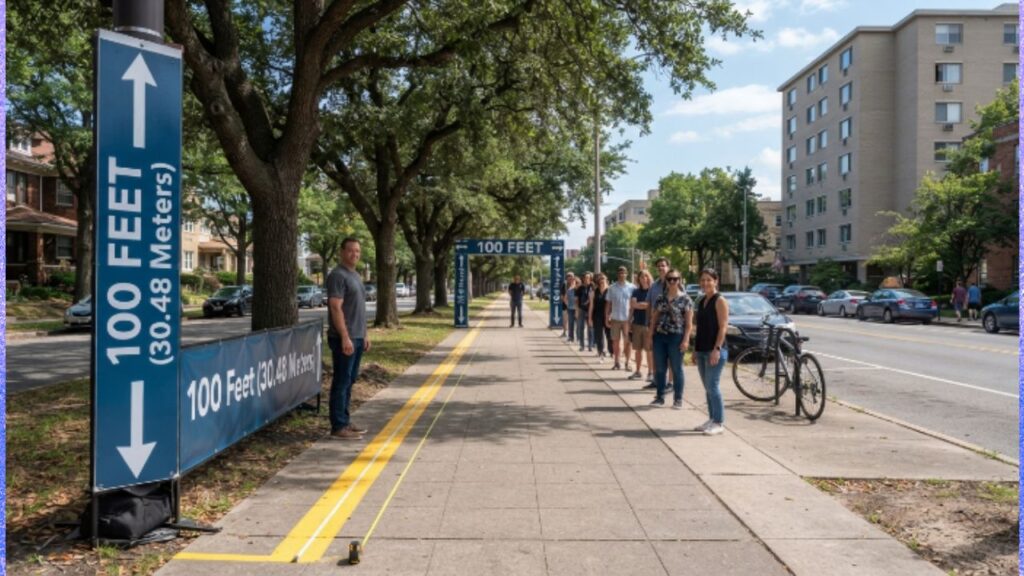
So, what does 100 feet look like? Imagine standing on one end of a straight path. At the other end, a person is standing roughly 30 meters away. You can clearly see them, of course, but you wouldn’t want to casually shout a quiet sentence and expect every word to arrive perfectly.
For visual distance estimation, 100 feet is long enough to feel substantial but not so long that the opposite end disappears. It’s a useful middle ground for understanding real-world scale.
Think about a small outdoor event. If a stage is placed 100 feet from the seating area, that’s not merely “a little way over there.” It creates a noticeable separation between the audience and performer. At a party, wedding, school function, or community event, that amount of space can become important when planning tables, entrances, pathways, booths, and sound equipment.
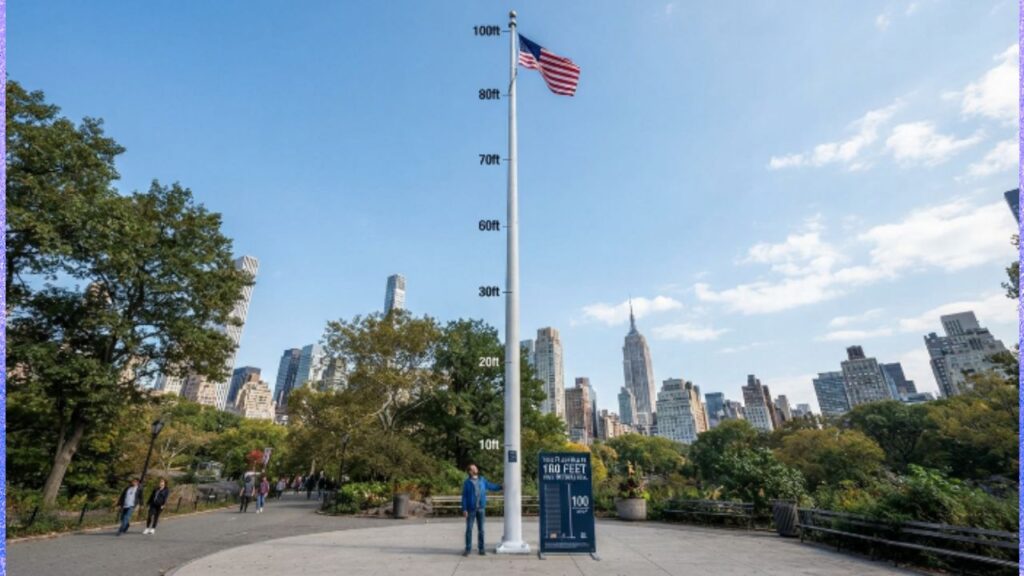
It also helps to remember that 100 feet distance can be horizontal or vertical. A 100-foot-long parking area and a 100-foot-tall building have the same numerical measurement, but they feel completely different to the eye.
100 Feet Compared to an NBA Basketball Court
One of the easiest ways to picture 100 feet compared to a basketball court is to use an NBA court. A standard NBA basketball court is 94 feet long.
That means 100 feet is about 6 feet longer than an NBA basketball court. In other words, if you stood at one baseline and imagined extending the court by another 6 feet, you’d be very close to the full 100-foot distance.
This makes the NBA basketball court length a particularly handy reference because many people have seen one either in person or on television. The National Basketball Association court gives you a familiar rectangle rather than an imaginary measuring line.
So, when somebody asks how far is 100 feet, you can say: picture a professional basketball court from end to end, then add roughly the height of an average adult person to that length. Thats a pretty good mental picture.
For event planning, this comparison can be useful too. A 100-foot stretch could accommodate a surprisingly long row of seating, activity stations, or fair booths depending on the arrangement and required walking space.
100 Feet Compared to a Cricket Pitch
Cricket offers another excellent length comparison, especially for people familiar with the sport.
A standard cricket pitch is 22 yards long, which equals 66 feet. Therefore, 100 feet is about one and a half cricket pitches.
More precisely, 100 feet divided by 66 feet is approximately 1.52. So imagine placing one cricket pitch end to end with another, then using roughly half of that second pitch. You’ve now created something close to 100 feet.
This is a useful example because the cricket pitch has a standardized size and provides a strong sense of spatial awareness. Someone who regularly watches or plays cricket may visualize 66 feet instantly, making the extra 34 feet easier to imagine.
For someone new to cricket, however, this comparison can be less intuitive. Thats why having several different reference objects is better than depending on just one.
100 Feet Compared to a Boeing 737
Aircraft provide a dramatic example of aircraft length comparison, although exact dimensions vary by Boeing 737 model.
Many Boeing 737 variants are around 100 feet or a little longer, depending on the specific version. Some commonly referenced 737 models are roughly 110 feet long. So a 100-foot distance is approximately the length of a smaller 737 configuration, while a longer version extends beyond it.
Imagine walking alongside a passenger aircraft from the nose toward the rear. That’s a much more tangible way to understand 100 feet in real life than simply reading “30.48 meters.”
An airplane is also useful because its size feels enormous when you’re standing next to it, yet 100 feet isn’t an unusually huge horizontal distance. This is a nice reminder that our perception of scale changes depending on what we’re comparing.
On an airport tarmac, for example, 100 feet can be a meaningful spacing distance between objects, vehicles, or operational areas. Real aviation planning uses precise measurements and safety standards, naturally, so this comparison is only for visualization.
100 Feet Compared to Cars and Sedans
Cars are probably among the easiest everyday reference points for visualizing distance.
An average sedan is often somewhere around 14 to 16 feet long, although vehicles vary quite a bit. If we use 15 feet as a rough reference, about six sedans lined bumper to bumper would total around 90 feet. Add another short section of roadway and you’ve reached approximately 100 feet.
Using vehicle length comparison makes the measurement easier to picture because almost everyone knows what a sedan looks like.
You can also imagine roughly six to seven ordinary cars arranged in a straight line. They won’t all be exactly the same length, so this isn’t a precision measuring method. It’s a mental model, and thats the point.
If you’re trying to estimate a driveway, parking lot, or small loading area, several cars parked nose-to-tail can give you a surprisingly useful distance comparison.
100 Feet Compared to a Semi-Truck Trailer
A standard semi-truck trailer is commonly around 53 feet long in the United States. Two 53-foot trailers would therefore total about 106 feet.
That makes two semi-truck trailers an excellent visual reference for 100 feet. Imagine one trailer placed directly after another. The combined length would be just a little longer than 100 feet.
This comparison is especially useful around a freight yard, loading dock, warehouse, or industrial property. If someone says a space is 100 feet long, picturing two trailers can immediately make the number less mysterious.
Of course, actual trucks need additional maneuvering room. A 100-foot straight section doesn’t mean a truck can safely turn, reverse, or park there with no extra clearance. Real construction planning and logistics use detailed site measurements, not eyeballing alone.
Still, for real-world scale, two trailers are hard to beat as a mental picture.
100 Feet Compared to School Buses
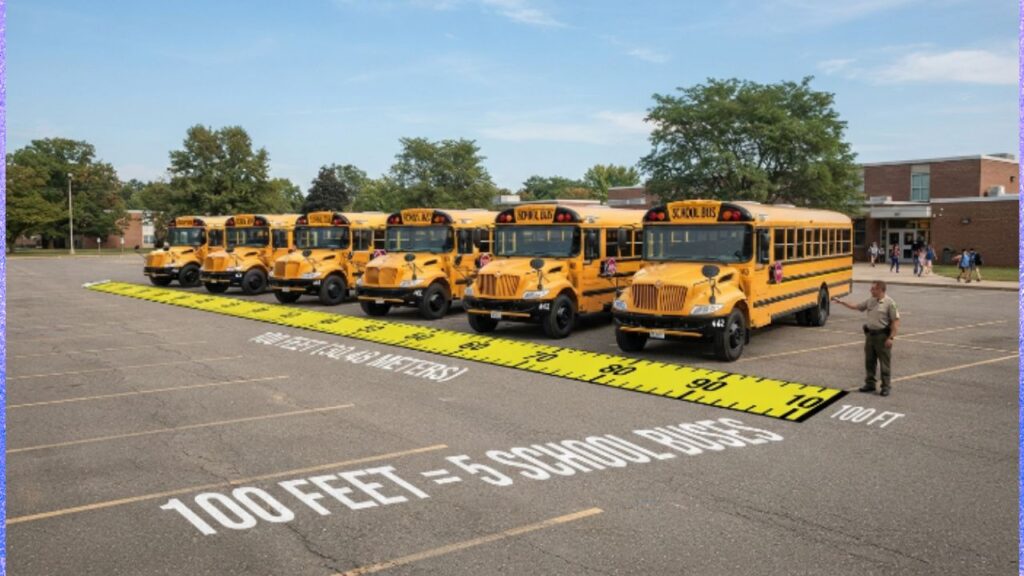
A typical school bus is roughly 35 to 45 feet long, depending on its design. If we use about 40 feet as a rough reference, two and a half buses would equal approximately 100 feet.
So another answer to what is 100 feet long could be: picture two full-size school buses and then about half of another one.
This is not an exact conversion because school buses come in several sizes. But it gives you a useful relative scale comparison, especially when you’re standing beside a road or school parking area.
If three buses are parked in a line, you’re likely looking at a distance somewhat greater than 100 feet. That makes the comparison practical for estimating a parking lot or school event layout.
100 Feet Compared to a Blue Whale
Nature gives us one of the most memorable comparisons.
A large Blue Whale can reach roughly 80 to 100 feet in length, with exceptional individuals sometimes exceeding that range. So a very large blue whale can be approximately as long as 100 feet.
Imagine a blue whale lying from nose to tail in a straight line. That enormous animal could stretch about the same distance as our measurement.
It’s a slightly strange comparison, admittedly, because most of us will never stand beside a blue whale and pull out a tape measure. But it creates powerful distance visualization. Suddenly, 100 feet isn’t just a number; it’s the length of one of the largest animals ever known to exist.
And yes, imagining one lying across a city street is probably the kind of thought that makes a boring measurement suddenly much more interesting.
100 Feet as the Height of a Building
A 100-foot measurement can also be vertical. A building around 100 feet tall might be roughly equivalent to a 10-story building, although actual floor heights vary.
If each story averages around 10 feet from floor to floor, ten floors would reach approximately 100 feet. But modern buildings often have higher ceilings, structural spaces, mechanical floors, and other variations, so this is a broad visualization rather than an architectural formula.
Standing below a 100-foot-tall building gives a completely different feeling from walking 100 feet across the ground. You have to tilt your head upward, and perspective starts doing its funny little magic.
This kind of urban height estimation is useful when thinking about apartment buildings, office blocks, telephone poles, and skyline planning. It also explains why building height matters in zoning laws, outdoor clearance, and urban design.
100 Feet Compared to Telephone Poles
Telephone and utility poles can vary significantly in height, but many common poles are in the neighborhood of 30 to 60 feet, with taller structures reaching considerably higher.
That means 100 feet might look like roughly two tall utility poles stacked conceptually from end to end. Obviously, we don’t literally stack poles, and don’t try that little experiment, please.
For height estimation, this reference can be helpful when looking at streets, utility corridors, or construction sites. If something appears twice as tall as a typical 50-foot pole, you’re approaching the 100-foot range.
Again, this is visual estimation rather than surveying. Professionals use instruments and exact site plans when a few feet can affect safety or engineering decisions.
How Many Walking Steps Are in 100 Feet?
A common question is how many steps are in 100 feet. There isn’t one universal answer because human walking steps aren’t identical.
If your average step is around 2.5 feet, then:
100 ÷ 2.5 = 40 steps
So roughly 40 walking steps could cover 100 feet for someone with a 2.5-foot stride.
A shorter stride might require more steps, while a longer stride requires fewer. You can improve your own walking distance estimation by measuring a known distance and counting your natural steps.
For example, walk 100 feet in a safe open area while counting normally. If you take 45 steps, you’ve learned something useful about your personal stride. Next time you need to estimate 100 feet, your own step count becomes a handy little measuring tool.
Don’t treat it like professional surveying, though. Counting steps to measure distance is practical, but it has limits.
How to Measure 100 Feet Without a Ruler
You don’t always need a giant measuring tape to estimate 100 feet.
One simple method is pacing. If your normal step averages about 2.5 feet, walk around 40 steps. Another method is using familiar objects, such as six or seven cars, two semi-trailers, or approximately one NBA basketball court plus a small extension.
You can also use a smartphone’s measuring or mapping features when greater accuracy matters. For serious construction planning, blueprint preparation, property work, or legal boundaries, however, use proper surveying equipment or professional measurements.
The goal of mental distance estimation isn’t perfect accuracy. It’s to develop spatial awareness so that “100 feet” starts meaning something physical in your mind.
Why 100 Feet Matters in Everyday Planning
A 100-foot distance can become surprisingly important in ordinary situations.
For party space planning, it might determine how far a stage sits from guests. For event layout planning, it can help you imagine the length of a row of booths. At a loading dock, it may influence how much room is available for vehicles. In a parking lot, it could determine how many vehicles fit in a straight line.
Outdoor events often depend on these kinds of measurements. Fair organizers, construction teams, school administrators, and venue planners all need some understanding of physical dimensions.
Even something as simple as deciding where to place tables can benefit from knowing whether you have 20 feet, 50 feet, or 100 feet of usable space. A number becomes much more useful when you can mentally walk through it.
A Quick 100-Foot Comparison Chart
Here are the most useful references together in one place, so you don’t have to wander back through the article looking for them.
| Real-world reference | Approximate relationship to 100 feet |
|---|---|
| NBA basketball court | 100 ft is slightly longer than the 94-ft court |
| Cricket pitch | About 1.5 cricket pitches |
| Blue whale | A large blue whale can approach 100 ft |
| Boeing 737 | Around the length of some variants; others are longer |
| Sedan | Roughly 6–7 sedans |
| Semi-truck trailer | About 2 trailers, slightly over 100 ft |
| School bus | Roughly 2–3 buses depending on size |
| Building | Around a 10-story building in a rough estimate |
| Walking | Around 40 steps for a 2.5-ft stride |
| Metric conversion | 30.48 meters |
These are visualization tools, not engineering specifications. Vehicle sizes, building dimensions, and animal lengths vary, so don’t use these examples as substitutes for exact length measurement.
The Difference Between 100 Feet of Distance and 100 Feet of Height
This little distinction is worth remembering.
When we say something is 100 feet long, we’re usually imagining a horizontal line. When we say a building is 100 feet tall, we’re thinking vertically. The number is identical, but the experience isn’t.
A horizontal 100-foot path might take less than a minute to walk. A 100-foot building can dominate the skyline around it. That’s because our brains interpret vertical scale differently from horizontal scale.
This matters in urban design, skyline planning, and outdoor clearance estimation. A 100-foot horizontal gap may feel comfortable, while a 100-foot vertical structure can feel huge from street level.
Measurements are objective, but our perception of them is wonderfully subjective.
A Simple Mental Trick for Visualizing 100 Feet
If you forget every comparison in this article, keep one mental shortcut: think one NBA court plus six feet.
That gets you remarkably close to 100 feet.
Or remember 30.48 meters if you prefer metric measurements. If you’re comfortable thinking in yards, picture about 33 yards. If inches are more natural for you, think 1,200 inches.
Different people visualize distance differently. Someone who works around cars might think in vehicles. A cricket fan might think in pitches. An architect might think in building dimensions. A runner might think in steps.
The best reference is the one your own brain understands fastest.
Frequently Asked Questions About 100 Feet
How long is 100 feet?
100 feet is equal to 30.48 meters, 1,200 inches, or about 33⅓ yards. It is slightly longer than an NBA basketball court.
What does 100 feet look like?
You can visualize 100 feet as roughly six or seven sedans lined up, two 53-foot semi-truck trailers, or about one and a half cricket pitches.
How many steps are in 100 feet?
For a person with an average step of about 2.5 feet, 100 feet is roughly 40 walking steps. Your exact step count will vary depending on your stride length.
How many meters is 100 feet?
100 feet equals exactly 30.48 meters. To convert feet to meters, multiply the number of feet by 0.3048.
Is 100 feet longer than a basketball court?
Yes. An NBA basketball court is 94 feet long, so 100 feet is about 6 feet longer than a regulation NBA court.
Read This Blog:https://mynoval.com/celsius-to-fahrenheit/
Final Thoughts on How Long 100 Feet Really Is
So, how long is 100 feet? Exactly 100 feet, naturally, but that answer doesn’t tell the whole story. It is 30.48 meters, 1,200 inches, or about 33⅓ yards. More importantly, it is a distance that can be translated into things you already know.
Picture an NBA basketball court with a little extra length. Imagine around six or seven sedans lined up. Think of two 53-foot semi-truck trailers. Visualize roughly one and a half cricket pitches. Think about a large blue whale stretching almost from one end of the distance to the other. Suddenly, 100 ft has a personality.
That is the real value of distance visualization. Measurements stop being cold numbers and start becoming physical ideas.
And perhaps that’s why measurements can be oddly meaningful in life. A family planning a celebration for a newborn daughter might worry about whether the venue is large enough, whether the stage is far enough away, or whether guests will have enough room to move around. The same 100-foot distance that sounds mathematical in a textbook can become part of a joyful memory when people gather together.
When you need to estimate 100 feet in real life, don’t stare at the number and hope your brain magically understands it. Give the number a familiar object. Walk it. Compare it. Picture it. Your sense of scale gets better with practice, and before long, 100 feet won’t feel mysterious at all.
If you’ve ever had a surprising experience with a distance or measurement, share your favorite comparison. Sometimes the strangest reference a school bus, a cricket pitch, or even a gigantic whale is the one that makes the number finally click.