


There’s something strangely comforting about a simple measurement. 20 feet sounds like a neat little number, almost too ordinary to notice, until you actually try to picture it. It can be the space between two people, the length of something sitting quietly in your driveway, or a distance that suddenly feels much farther once you have to walk it. And, in a completely different kind of life moment, I’ve always thought welcoming a baby girl creates that same feeling of trying to understand something bigger than a number. A tiny person arrives, and somehow the whole room feels enormous with possibility. Funny how measurement and emotion can bump into each other like that.
If you’re wondering how long is 20 feet, the clean mathematical answer is 240 inches, 6.096 meters, or about 6.1 meters. But numbers alone don’t always help your brain “see” a length. You can read 20 feet ten times and still have no proper idea what it looks like in real life. So, let’s turn this measurement into things you already know cars, rooms, boats, parking spaces, sports courts, and a few surprisingly large objects.
How Long Is 20 Feet in Simple Measurements?
The easiest way to understand 20 feet is to break it into familiar units. One foot equals 0.3048 meters, which is the standard conversion factor used for an exact feet-to-meters conversion. Multiply 20 by 0.3048, and you get 6.096 meters.
So, the basic conversion looks like this:
| Measurement | Equivalent |
|---|---|
| 20 feet | 240 inches |
| 20 ft | 6.096 meters |
| 20 feet | 6.1 meters approximately |
| 20 feet | 6⅔ yards |
| 20 feet | About 7–10 walking steps |
The 6 meters figure you sometimes see is only a rounded approximation. The exact answer is 6.096 meters, while 6.1 meters is usually easier for everyday length measurement. Tiny difference, big lesson: measurements have a habit of becoming less tidy once real life gets involved.
An average adult step is often around 2.5 feet, although walking style and body size change that quite a bit. Using that rough estimate, 20 feet is about eight steps. Some people may cover it in seven long steps, while another person might need ten. So if someone says, “Walk about eight steps,” they’re giving you a surprisingly decent rough distance measurement.
What Does 20 Feet Look Like?
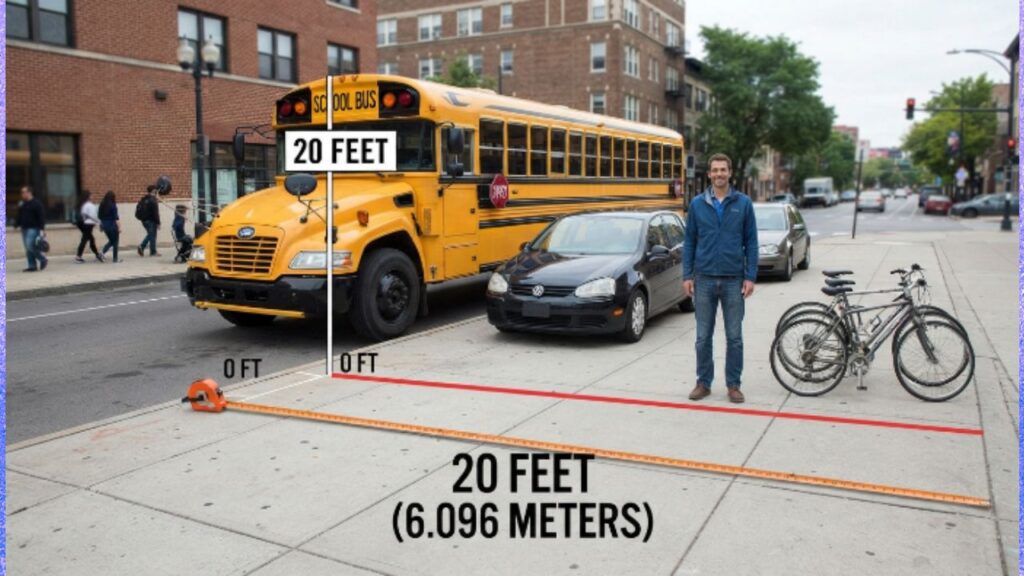
So, what does 20 feet look like when you’re standing somewhere without a tape measure? Imagine placing two points on the ground and stretching an invisible line between them. The line would be long enough to cross a decent-sized room, span much of a driveway, or sit roughly alongside a normal parking space.
It isn’t enormous. But it’s certainly not tiny either.
For size visualization, imagine an adult standing at one end and another person standing at the opposite end. You’d need to raise your voice a little if there was traffic, wind, or general neighborhood chaos going on. That’s where 20 feet visually starts making sense: it’s a substantial everyday distance, not a giant one.
Another easy trick is to picture about eight ordinary walking steps. Take those steps in a straight line next time you’re outside. Stop after the eighth one and look back. Your brain suddenly gets a much better idea of 20 feet distance than it does from the number “20.”
17 Things That Are 20 Feet Long
Now for the fun part. Not every item below is exactly 20 feet, because real-world objects come in different models and dimensions. Think of these as 20-foot length examples or objects that can be around 20 feet. A few are especially close, while others are useful comparisons for developing spatial awareness.
1. A Standard Parking Space
A typical parking space can be roughly 18–20 feet long, depending on the location and parking design. That makes a parking space one of the easiest ways to visualize 20 feet.
Picture your car sitting in a parking bay. From the front line to the back line, you may be looking at something surprisingly close to 20 feet. It’s why a parking lot is such a useful place for informal distance estimation.
If you’ve ever looked at a parking space and thought, “That’s not really that long,” well… twenty feet is hiding right there under your tyres.
2. A 20-Foot Shipping Container
This one is almost cheating, but in the best possible way. A 20-foot shipping container is specifically designed around a nominal 20-foot length, making it one of the clearest examples of things that are 20 feet long.
These containers are heavily used in logistics, shipping, freight handling, and global trade. They’re transported by ships, trains, and trucks as part of the worldwide shipping industry.
When you see one in a port or storage yard, you’re basically looking at a giant physical ruler with walls.
3. A Large Living Room
A spacious living room can easily have one dimension close to 20 feet. A room measuring around 20 feet from one wall to the opposite wall gives you a very practical 20-foot room layout comparison.
Imagine a sectional sofa, coffee table, television, and some walking space spread across that length. Suddenly, the abstract number becomes an actual part of interior design.
For homeowners, understanding this scale can help with furniture layout, flooring calculations, and interior layout planning. Twenty feet gives you enough room to create distinct areas without the room feeling like a warehouse.
4. A Long Compact Car Plus Extra Space
Most everyday cars are around 14–16 feet long. A Honda Civic, for example, is nowhere near 20 feet, but placing a typical car beside a 20-foot line makes the difference easy to understand.
Think of a normal car length, then add several more feet at one end. That extra stretch is what pushes you toward 20 feet.
So, if you’re asking about 20 feet compared to a car, picture roughly one car plus another four to six feet. That’s a much more useful mental image than staring at a conversion chart.
5. A Pickup Truck With Room to Spare
A Toyota Tacoma or Ford Ranger can help provide another familiar reference point. Depending on the cab and bed configuration, these compact pickup trucks are often somewhere in the 17–19-foot neighborhood.
That means a longer pickup truck can come surprisingly close to 20 feet.
Stand beside one in a dealership parking lot and imagine stretching it another couple feet. Yep, you’re getting there.
6. A Small Boat
A small boat around 20 feet long is a very common size in recreational boating. A 20-foot boat gives enough length for a useful seating area, storage, and equipment without becoming a massive vessel.
Picture a boat trailer carrying a vessel that stretches from one end to the other. The boat trailer itself may add additional length, so the complete transportation setup can be considerably longer than the boat alone.
This is a nice real-world example because the length is easy to observe from outside.
7. A Large Canoe or Canoe Setup
Most recreational canoes are shorter than 20 feet, but long racing or specialized canoes can approach or exceed that length. If you imagine several standard canoes arranged end-to-end, the scale becomes obvious.
A regular canoe might make 20 feet seem distant at first. Put two together mentally, though, and you’ve almost doubled the measurement. Add a little overlap or space, and there’s your 20-foot comparison.
The humble paddle suddenly looks very small beside that imaginary line.
8. A Long Construction Beam
In construction, beams and structural materials are frequently manufactured in long standard lengths. A construction beam measuring 20 feet is a useful example of how this measurement appears in building projects.
Imagine workers carrying a long beam across a site. It can look much longer when it’s being moved through a narrow space, too. The surrounding environment changes your perception, which is exactly why size visualization matters in construction.
Twenty feet in an open yard feels manageable. Twenty feet of timber in a cramped hallway? Suddenly everyone is doing geometry with their elbows.
9. A Spacious Walk-In Closet
A walk-in closet can have a dimension of around 20 feet in a large home, especially when designed as a dressing room rather than a simple storage closet.
A 20-foot-long closet could include hanging sections, shelves, drawers, mirrors, and a central seating area. At that point, calling it merely a closet feels almost disrespectful.
For home design, measuring this distance helps with planning storage, walking clearance, lighting, and furniture placement.
10. A Backyard Garden
A backyard garden measuring 20 feet from one end to the other is not unusual. Imagine a rectangular garden with plants arranged along both sides and a small pathway running through the middle.
That length gives enough space for flowers, vegetables, shrubs, and perhaps a tiny seating corner.
For landscaping planning, a 20-foot stretch can be especially useful because it’s large enough to create visual layers but still manageable for a residential outdoor space.
11. A Hallway in a Large Home
A residential hallway can be 20 feet long, especially in larger homes or properties with multiple rooms branching from a central corridor.
Walk down a long hallway and count your steps. Around eight average steps can put you close to 20 feet.
It’s also a good reminder that perceived distance changes indoors. A hallway may feel longer because the walls create a tunnel-like effect, while the same 20-foot distance outdoors can seem much shorter.
12. A Long Sectional Sofa Arrangement
A single sectional sofa is generally much shorter than 20 feet, but a very large modular arrangement can approach this scale when multiple sections are combined.
Imagine a giant seating arrangement running along a wall. The furniture itself doesn’t need to be exactly 20 feet to help with visualization. You’re looking for something that occupies a similar horizontal span.
This comparison can be surprisingly useful when planning a seating area in a large living room.
13. A Recreational Vehicle
Some compact RV models can approach 20 feet in length, while many larger recreational vehicles are considerably longer.
A 20-foot RV is interesting because it combines length with height and width. Unlike a line painted on the ground, you’re seeing a genuine three-dimensional object.
That makes it useful for understanding vehicle size, parking requirements, turning space, and transportation planning.
14. A Short Outdoor Structure
A small garage extension, garden structure, workshop, or other outdoor structure can measure around 20 feet on one side.
Imagine standing at one corner of the structure and looking toward the opposite end. If it’s 20 feet long, the span should feel similar to crossing a large room.
This comparison works nicely when thinking about backyard improvements, DIY projects, sheds, patios, or small construction plans.
15. Part of a Freight Train Car
A freight train is obviously far longer than 20 feet. Some freight train cars, however, can be roughly several times that length, depending on the car type.
That makes a freight train useful mostly as a scale comparison rather than an exact example. If you stand near a railway carriage and imagine dividing its length into sections, one section might give you a rough sense of 20 feet.
It’s a good reminder that freight, rail transport, and industrial infrastructure operate on dimensions much larger than most residential spaces.
16. A Long Residential Room
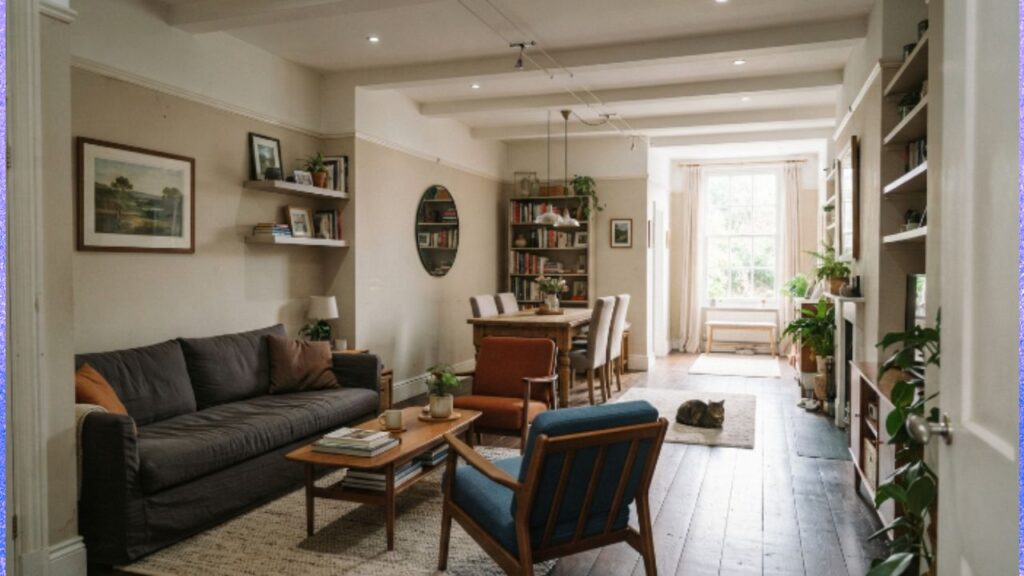
A residential room measuring 20 feet on one side can feel quite generous. A 20-by-12-foot room, for example, has enough space for substantial furniture while still allowing movement.
This is where room dimensions become more meaningful than isolated numbers. A 20-foot length tells you one thing, but pairing it with width gives you a better understanding of the room’s total usable space.
Interior designers use these relationships constantly when planning flooring, storage, walls, lighting, and furniture.
17. A Long Outdoor Distance Between Two Features
Sometimes the easiest “object” is not an object at all. The distance between a tree and a fence, two garden beds, a driveway entrance and a gate, or two outdoor structures can be approximately 20 feet.
Imagine placing a tree at one end and a garden bench at the other. Walk eight average steps between them. That gives you a rough practical approximation.
It’s one of the simplest ways to visualize 20 feet without owning a measuring tool.
How Far Is 20 Feet in Walking Steps?
If you’re wondering how far is 20 feet while standing somewhere without a ruler, walking steps are a handy shortcut.
Using an average adult step of about 2.5 feet:
20 ÷ 2.5 = 8 steps
So, roughly 8 walking steps equals 20 feet.
But don’t treat this as laboratory-grade measurement. A tall person with a long stride may cover the distance in fewer steps, while a shorter person could need more. Even your walking speed can change stride length a little.
For a quick estimate, though, eight ordinary steps is a perfectly reasonable starting point.
20 Feet Compared With a Tennis Court
A standard tennis court is about 78 feet long, so 20 feet represents a little over one-quarter of the court’s length.
Imagine standing on the baseline and looking toward the net. The entire court is much longer than 20 feet. If you mentally divide the court length into four sections, one section is about 19.5 feet.
That makes 20 feet compared to a tennis court surprisingly easy to picture.
The tennis serve, court markings, and baseline-to-net arrangement also give athletes a strong sense of spatial awareness. Players don’t need to carry measuring tapes around; their brains learn distances through repetition.
20 Feet Compared With a Basketball Court
Basketball gives another interesting reference. The basketball free-throw line is traditionally about 15 feet from the backboard or the appropriate reference point at the hoop.
That means 20 feet is roughly five feet farther than the familiar 15-foot free-throw distance.
If you have watched NBA games, you’ve seen players repeatedly operate around this scale. A 20-foot distance isn’t some huge athletic expanse—it’s a manageable section of a basketball court.
And yes, watching a player like Dirk Nowitzki shoot from well beyond the free-throw line makes 20 feet look almost suspiciously small.
20 Feet Compared With a School Bus
A typical school bus is often around 35 feet long, although sizes vary. So a 20-foot measurement is noticeably more than half the length of a full-size school bus.
A short bus, on the other hand, can be much closer to the 20-foot range, depending on the model.
This makes school buses useful because most people already have a rough mental picture of one. If you imagine a full-size bus and mentally cut away around 40 percent of its length, the remaining portion gives you a rough feeling for 20 feet.
What Is 20 Feet Equal to in Meters?
The exact 20 feet in meters conversion is:
20 × 0.3048 = 6.096 meters
Therefore:
20 feet = 6.096 meters
For ordinary conversation, you can round that to:
20 feet ≈ 6.1 meters
If someone says “about 6 meters,” they’re close, but 6.096 meters is the accurate conversion.
This distinction matters more in engineering, construction, science, and technical work than it does when you’re measuring a garden. Nobody is usually going to argue with you over 9.6 centimeters while planting tomatoes.
How to Measure 20 Feet Without a Tape Measure
You don’t always need special equipment for a rough 20 feet measurement. Here are several practical methods.
Use Your Walking Steps
Walk naturally for about eight steps, assuming your average stride is close to 2.5 feet. This is quick, but only approximate.
Use a Known Object
A typical car is around 14–16 feet. Place the imagined distance beside the car and add another four to six feet.
Use a Parking Space
If the parking space is approximately 18–20 feet, its markings provide a useful real-world reference.
Use a Measuring App
Modern smartphones can use augmented-reality measurement tools. These are convenient, though results can vary depending on lighting, surfaces, and device sensors.
Use Rope or String
If accuracy matters but you don’t have a tape measure, a rope marked at a known length can help. Measure the rope carefully first, then use it as a reference.
For serious construction, furniture installation, or structural work, however, use a proper measuring tool. Distance estimation is great for curiosity, but it isn’t a substitute for precision when mistakes cost money.
Why Visualizing 20 Feet Is Actually Useful

You might wonder why anyone bothers learning how to visualize 20 feet. It’s more useful than it first appears.
Understanding distances helps with parking, home projects, sports, landscaping, furniture placement, photography, construction, and general spatial awareness.
If someone tells you a garden is 20 feet long, you can imagine its scale. If a room is 20 feet wide, you can picture the likely furniture arrangement. If a boat is 20 feet long, you can understand whether it might fit into a particular storage area.
That mental ability is essentially distance visualization—turning numbers into something your brain can actually see.
A Quick 20-Foot Comparison Table
| Object or reference | Approximate size | How it compares with 20 feet |
|---|---|---|
| Parking space | 18–20 ft | Very close |
| Shipping container | 20 ft nominal | Exact reference |
| Typical car | 14–16 ft | Shorter |
| Compact pickup truck | Around 17–19 ft | Close |
| Short bus | Varies | Can be near this size |
| Full-size school bus | Around 35 ft | Much longer |
| Tennis court | 78 ft | About 4× longer |
| Free-throw distance | 15 ft | 5 ft shorter |
| Large living room | Around 20 ft | Can be very close |
| Small boat | Around 20 ft | Very close |
| Large walk-in closet | Around 20 ft | Possible |
| Backyard garden | Around 20 ft | Common practical comparison |
FAQs About How Long Is 20 Feet?
How long is 20 feet?
20 feet equals 240 inches, 6.096 meters, or approximately 6.1 meters. It’s roughly eight average adult walking steps.
What does 20 feet look like?
20 feet can look similar to a standard parking space, a 20-foot shipping container, or the length of a spacious living room.
How many meters are in 20 feet?
There are exactly 6.096 meters in 20 feet. For everyday use, you can round this to 6.1 meters.
How far is 20 feet in walking steps?
For an average adult stride of about 2.5 feet, 20 feet is approximately 8 walking steps, though individual stride lengths vary.
What are some things that are 20 feet long?
Examples include a 20-foot shipping container, some small boats, large rooms, certain pickup trucks, and parking spaces that measure close to 20 feet.
Read This Blog:https://mynoval.com/celsius-to-fahrenheit/
Final Thoughts: Making 20 Feet Feel Real
So, how long is 20 feet? Exactly 240 inches, 6.096 meters, or approximately 6.1 meters. But the better answer depends on what your brain already understands.
It can look like a parking space. It can be the nominal length of a shipping container. It can stretch across a generous living room, run along a garden, or resemble the length of a small boat. It is about eight average adult steps, and it is a little longer than the distance from a basketball hoop to the traditional free-throw line.
The magic of real-life measurement is that numbers become much less mysterious once you attach them to ordinary things. Twenty feet stops being an abstract figure and becomes a piece of your driveway, a room in your home, or eight casual steps across the pavement.
And perhaps that’s why measurements can feel oddly personal. We measure rooms before filling them, gardens before planting them, and distances before deciding whether something is close enough. Even the arrival of a baby girl changes our sense of space in a funny way suddenly a tiny blanket can occupy an entire universe of attention, and a small room can feel bigger simply because somebody new is in it.
If you need to remember one thing, remember this: 20 feet is about 6.1 meters and roughly eight average walking steps. Keep that little mental ruler tucked away. You’ll probably use it more than you expect.
And next time somebody asks, “What does 20 feet look like?” you won’t have to stare at the number and guess. You can just point toward a parking space, take a few steps, and say, “About this much.” Sometimes, that’s the most useful kind of measurement there is.