
There’s something oddly quiet about sitting at the kitchen table after your child has gone to bed, calculator open, school papers scattered around like tiny paper boats that forgot where the river was. I remember talking with a parent who laughed for about three seconds before saying, “Education is the only thing I happily overthink.” It sounded funny at first, but honestly, it kinda stayed with me.
If you’re searching for Kumon cost, chances are you’re not just looking for numbers. You’re wondering whether those numbers eventually become confidence, stronger grades, calmer homework evenings, and maybe even a child who doesn’t sigh dramatically every time math appears. That’s a very different question.
In 2026, families across the United States, from New York to Miami, continue comparing tutoring options more carefully than ever before. Rising education expenses have made every subscription, class, and worksheet feel like a decision rather than just another payment. Parents now compare Kumon, Brighterly, private tutors, online academies, and even homeschool resources before choosing what fits both their child and their wallet.
This guide breaks down everything you should know about Kumon pricing, fees, value, hidden costs, alternatives, and whether it’s actually worth the investment.
| Kumon Fee | Typical Cost (USD) |
|---|---|
| Registration Fee | $30–$80 |
| Monthly Cost (1 Subject) | $150–$220 |
| Monthly Cost (2 Subjects) | $300–$440 |
| Annual Cost (1 Subject) | $1,800–$2,640 |
| Annual Cost (2 Subjects) | $3,600–$5,280 |
What Is Kumon and How Does It Work?

Before discussing Kumon prices, it’s important to understand what families are actually paying for.
Kumon is one of the world’s largest supplementary education providers, focusing primarily on the Kumon Math Program and Kumon Reading Program. Rather than relying heavily on classroom teaching, the program encourages independent learning, daily practice, and consistent improvement through structured worksheets.
Students usually attend local Kumon Offline Learning Centers once or twice each week while completing daily assignments at home. Some locations also provide Kumon Online Learning, allowing students to interact remotely while following the same learning philosophy.
Instead of racing through lessons, children gradually master one skill before moving to another. It feels almost slow on purpose, and honestly…that’s kinda the point.
The approach emphasizes:
- Worksheet-based learning
- Independent study
- Daily practice
- Strong study habits
- Progress tracking
- Regular learning assessment
- Long-term skill development
- Improved math proficiency
- Better reading proficiency
- Growing academic confidence
Kumon Cost in 2026: Average Monthly Pricing
Now let’s answer the question everyone searches.
The exact Kumon cost depends on your location because each franchise operates independently. However, average tuition across the United States generally falls within these ranges.
| Fee Type | Average Cost (USD) |
|---|---|
| Registration Fee | $30–$80 |
| Placement Assessment | Usually Included |
| Monthly Fee Per Subject | $150–$220 |
| Math + Reading | $300–$440 |
| Materials | Sometimes Included |
| Annual Cost (One Subject) | $1,800–$2,640 |
| Annual Cost (Two Subjects) | $3,600–$5,280 |
Since pricing varies by learning center, parents should always contact their local instructor for exact Kumon tuition.
Kumon Cost Breakdown: Every Fee You Should Expect
Looking only at monthly tuition can be a little misleading. Sometimes the first payment feels noticeably higher because several charges arrive together.
A typical Kumon cost structure may include:
- Kumon enrollment fee
- Kumon registration fee
- Monthly tuition fees
- Worksheet materials
- Learning assessments
- Replacement workbook charges if needed
- Optional center-specific administrative fees
Some centers include materials inside tuition while others separate them. It’s worth asking upfront because small fees have a funny habit of becoming not-so-small after several months.
When comparing Kumon pricing transparency, asking for a written breakdown is always a smart move.
Kumon Cost Per Month vs Kumon Cost Per Year
Parents often search for How much does Kumon cost per month without realizing the yearly picture matters much more.
For one subject:
- Monthly Kumon tuition: around $150–$220
- Estimated yearly investment: $1,800–$2,640
For two subjects:
- Monthly total: approximately $300–$440
- Estimated yearly investment: $3,600–$5,280
That means a family enrolling two children in both reading and math could spend well over $8,000 annually depending on location.
When viewed that way, Kumon annual cost becomes less about one payment and more about long-term educational planning.
What Affects Kumon Pricing?
Not every center charges identical amounts.
Several factors influence Kumon pricing plans:
- Local operating costs
- Instructor discretion
- Regional demand
- Number of enrolled subjects
- Available promotions
- State-specific business expenses
- Local competition
- Learning center size
A center in New York may naturally charge more than one located in a smaller town due to higher operating expenses.
Kumon Online Learning vs Kumon Offline Learning Centers
The growth of Kumon Online Learning has given parents another option.
Online learning usually provides:
- Digital instructor interaction
- Flexible schedules
- Home convenience
- Similar worksheet system
- Remote progress reviews
Meanwhile, Kumon Offline Learning Centers offer:
- Face-to-face guidance
- Better accountability
- Direct observation
- More structured routines
- Physical learning environment
Pricing often remains fairly similar because the educational model doesn’t change dramatically.
The choice usually comes down to your child’s personality rather than pure cost.
Is Kumon Worth the Money?
This is probably the biggest question after How much does Kumon cost.
The answer depends on your child.
Students who naturally respond well to:
- Daily routines
- Repetition
- Independent learning
- Self-discipline
- Homework practice
- Gradual mastery
often experience excellent results.
Children who require frequent explanations, interactive teaching, or game-based activities may struggle more.
Parents sometimes expect dramatic improvements within a month, but Kumon’s philosophy is built around consistency instead of quick wins.
As education consultant Sandra Garcia once noted during discussions about structured learning, “Small daily habits often outperform occasional bursts of motivation.” That idea mirrors Kumon’s long-term approach quite nicely.
Kumon Reviews: What Parents Usually Say
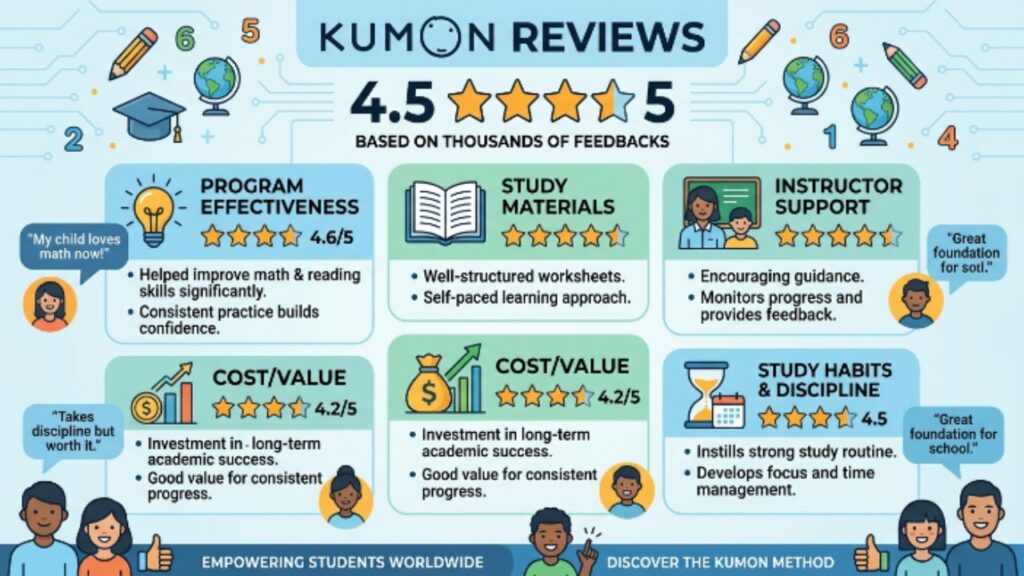
Looking across Trustpilot, parenting forums, and Reddit, several patterns appear repeatedly.
Positive Kumon reviews often mention:
- Improved discipline
- Better homework independence
- Increased confidence
- Strong arithmetic skills
- Reading improvement
- Consistent learning routine
Common criticisms include:
- Repetitive worksheets
- High monthly costs
- Limited one-on-one instruction
- Heavy daily workload
- Less flexibility for busy families
No educational program receives universal praise, honestly. Children aren’t identical, so programs shouldn’t be expected to work identically either.
Kumon vs Brighterly
One comparison parents frequently make is Kumon vs Brighterly.
| Feature | Kumon | Brighterly |
|---|---|---|
| Learning Style | Independent worksheets | Live tutoring |
| Sessions | Self-paced | One-on-one |
| Homework | Daily | Guided practice |
| Focus | Repetition | Personalized instruction |
| Flexibility | Moderate | High |
| Parent Interaction | Limited | Frequent |
Brighterly Math Tutoring focuses on personalized online instruction with real tutors, while Brighterly Reading Tutoring offers guided support instead of primarily independent worksheets.
Parents comparing Brighterly pricing often appreciate that tutoring can feel more interactive, although costs vary depending on lesson frequency.
If your child thrives with conversation and immediate explanations, Brighterly may feel more engaging.
If your child becomes stronger through repetition and routine, Kumon may be the better match.
Kumon Cost vs Private Tutoring
Private tutoring can cost anywhere from $30 to over $100 per hour depending on qualifications and location.
Compared with private tutoring, Kumon offers:
- Lower long-term hourly cost
- Structured curriculum
- Consistent worksheets
- Daily reinforcement
Private tutors generally provide:
- Immediate feedback
- Customized lessons
- Faster adjustment
- Flexible teaching styles
Neither is automatically better.
It’s really about matching teaching style to the learner.
Hidden Fees Parents Sometimes Forget
When researching Kumon hidden fees, families occasionally overlook indirect expenses.
Possible additional costs include:
- Transportation
- Extra educational materials
- Lost worksheet replacement
- Additional subjects
- Time commitment
- Opportunity cost for extracurricular activities
These aren’t necessarily “hidden” in a misleading sense, but they’re easy to forget while comparing monthly tuition alone.
Are There Discounts?
Some centers provide:
- Kumon sibling discounts
- Kumon seasonal discounts
- Promotional enrollment events
- Reduced registration during local campaigns
Availability varies because centers operate independently.
Always ask directly.
Many parents never realize discounts existed simply because they didn’t ask the question.
Kumon and Educational Standards
Although Kumon follows its own progression rather than school textbooks, many families feel it complements US Educational Standards.
The program supports:
- Basic mathematics
- Reading comprehension
- Independent problem-solving
- Study discipline
- Homework consistency
Students preparing for advanced academics, including SAT preparation, often benefit indirectly from stronger foundational skills.
Its emphasis also aligns well with many STEM-based curriculum goals, especially regarding logical thinking and mathematical fluency.
Educational professionals including Lawrence C. Ragan have long emphasized the importance of self-directed learning in lifelong education, while educators like Lorraine J. Ramirez Villarin have discussed how structured learning habits contribute to sustained academic development. Although their work isn’t specific to Kumon, the broader educational principles overlap in meaningful ways.
Parent Budgeting: Is Kumon a Good Educational Investment?
Every family views education differently.
Some see tutoring as an expense.
Others see it as an investment.
When evaluating Cost vs value, ask yourself:
- Is my child improving?
- Are homework battles decreasing?
- Has confidence increased?
- Is learning becoming more independent?
- Are study habits improving?
- Can we comfortably afford the tuition?
If the answers remain “yes” after several months, many parents consider the program worthwhile.
If not, exploring alternatives may be perfectly reasonable.
Kumon Alternatives Worth Considering
Families comparing Kumon alternatives often evaluate:
- Brighterly
- Local tutoring centers
- Online tutoring platforms
- Homeschool curriculum providers
- Private tutors
- School-based academic support
- Educational technology apps
Each offers different strengths regarding flexibility, interaction, pricing, and teaching philosophy.
No single learning program fits every child, and that’s actually okay.
Tips Before Enrolling Your Child
Before paying the Kumon enrollment cost, consider these questions.
- Request a placement assessment.
- Ask for complete Kumon pricing in writing.
- Understand all recurring fees.
- Ask about cancellation policies.
- Discuss realistic progress expectations.
- Learn how much homework is assigned.
- Check instructor availability.
- Ask about discounts.
- Compare at least two tutoring providers.
Doing a little homework before signing up can save both money and frustration later.
Frequently Asked Questions (FAQs)
How much does Kumon cost per month?
The average Kumon cost per month ranges from $150 to $220 per subject, depending on your location and learning center.
Is there a Kumon enrollment fee?
Yes, most centers charge a Kumon enrollment fee or registration fee, typically between $30 and $80.
Is Kumon worth the money?
For many families, Kumon is a worthwhile educational investment if their child benefits from independent learning, daily practice, and consistent skill development.
What is included in Kumon tuition?
Kumon tuition usually includes weekly class sessions, daily worksheets, progress monitoring, and instructor support. Some centers may charge extra for materials.
Is there a difference between Kumon Online Learning and in-center classes?
Both follow the same curriculum, but Kumon Online Learning offers remote instruction while in-center classes provide face-to-face guidance and support.
read this blog:https://mynoval.com/8-inches-long-2/
Final Thoughts on Kumon Cost in 2026
Understanding Kumon cost is about much more than comparing tuition numbers.
Yes, monthly fees matter. Annual expenses matter too. But the real question quietly hiding underneath every price tag is whether the program helps your child become a more confident learner.
For some students, Kumon’s structured worksheets build remarkable independence. Others may flourish with personalized tutoring, interactive lessons, or a completely different learning style. Neither path is wrong, they’re simply different roads heading toward the same destination.
Education is rarely the cheapest investment a family makes, but when it genuinely improves confidence, discipline, and lifelong learning habits, its value can extend far beyond a report card.
Before making your final decision, compare local Kumon pricing, review different tutoring options, ask detailed questions, and think about your child’s personality as much as your family budget. The best learning program isn’t always the most expensive one or the most popular one it’s the one your child actually enjoys enough to keep showing up for.
Have you enrolled your child in Kumon or explored another tutoring program? Share your experience, favorite learning tips, or questions in the comments. Your story might end up helping another parent make a thoughtful decision, and thats a pretty nice thing to pass along.