

I still remember the first time the Unit Circle stopped looking like a plain circle scratched onto notebook paper and started behaving like a tiny map of ideas. It was late afternoon, the kind where sunlight sneaks across the desk in crooked little strips, and I kept staring at one simple point wondering why such a small drawing could explain so many big things. Funny enough, nobody had told me the Tangent was quietly waiting there, almost hiding behind the comfort of sine and cosine.
A lot of students meet Trigonometry with slightly worried faces. I did too, honestly. Angles, formulas, graphs… they all seem to arrive together like guests who forgot to knock. But once you understand how the Unit Circle with Tangent works, those scattered mathematical pieces begin fitting together in a surprisingly natural way. It isnt magic exactly, though sometimes it feels close enough.
Whether you’re learning for school, preparing for competitive exams, or simply trying to finally understand why the tangent becomes undefined at certain angles, this guide will walk through everything in an easy, practical way. Along the road we’ll explore definitions, formulas, coordinate relationships, examples, and everyday tricks that make remembering tangent values much easier than most textbooks pretend.
| Angle | Coordinates (cos θ, sin θ) | Tangent (tan θ) |
|---|---|---|
| 0° | (1, 0) | 0 |
| 30° | (√3/2, 1/2) | √3/3 |
| 45° | (√2/2, √2/2) | 1 |
| 60° | (1/2, √3/2) | √3 |
| 90° | (0, 1) | Undefined |
What Is the Unit Circle With Tangent?
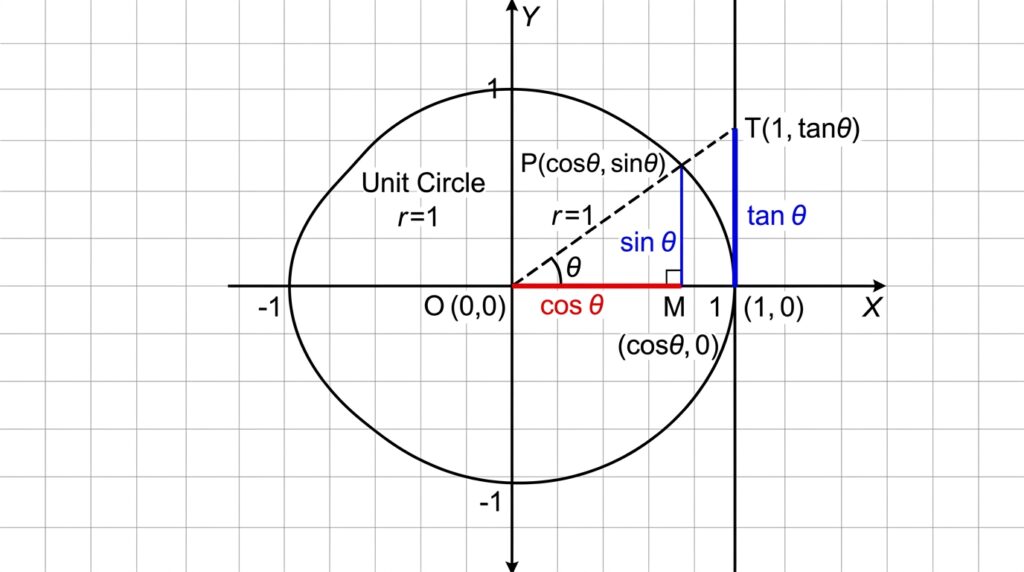
The Unit Circle with Tangent is one of the most useful visual tools in Trigonometry because it connects angles, coordinates, and the Tangent Function into one elegant picture. At first glance it is simply a Circle centered at the Origin (0,0) of the Coordinate Plane, but every tiny point around its edge tells a mathematical story.
The circle has a Unit Radius, meaning its Radius equals exactly one unit. Since the Circle is centered at the Origin (0,0) inside the Cartesian Coordinate System, its equation becomes:
[
x^2+y^2=1
]
That tiny equation carries an enormous amount of meaning. Every Coordinate Point on the circle satisfies it.
When measuring an Angle, we always begin from the Positive x-axis. Rotating in a Counterclockwise Rotation gives positive angles, while clockwise movement produces negative angles. This standard convention keeps every calculation consistant, even though it can seem a little picky at first.
The coordinates of every point become:
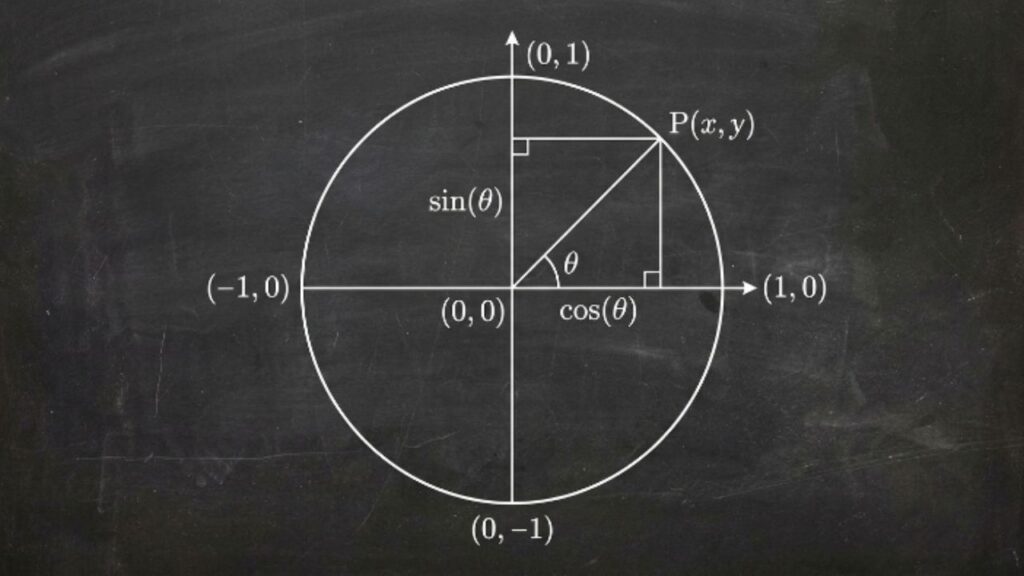
- Coordinates (x, y) = (Cosine (cos θ), Sine (sin θ))
- Theta (θ) represents the angle.
- Angles may be measured in Degrees or Radians.
- Every point lies exactly one Unit Distance from the center.
Once these coordinates are known, the Tangent (tan θ) becomes surprisingly simple.
Unit Circle Tangent Definition Explained Clearly
The official Tangent Definition says that tangent equals the ratio of sine to cosine.
Mathematically,
[
\tan(\theta)=\frac{\sin(\theta)}{\cos(\theta)}
]
This means the Ratio of Sine to Cosine forms the Tangent Ratio.
Inside the Unit Circle, every point already gives us both sine and cosine.
If a point is
[
(x,y)
]
then
- Cosine (cos θ) = x
- Sine (sin θ) = y
Therefore,
[
\tan(\theta)=\frac{y}{x}
]
Suddenly the Tangent Function on the Unit Circle doesn’t feel mysterious anymore. It’s simply comparing the vertical movement to the horizontal movement. I always found that oddly satisfying, maybe because it feels almost too simple after hearing people describe tangent as something difficult.
The tangent also represents the Slope of the line connecting the origin to the point on the circle. That’s where Geometry quietly shakes hands with Algebra, and they somehow become friends.
Understanding the Geometry Behind the Tangent
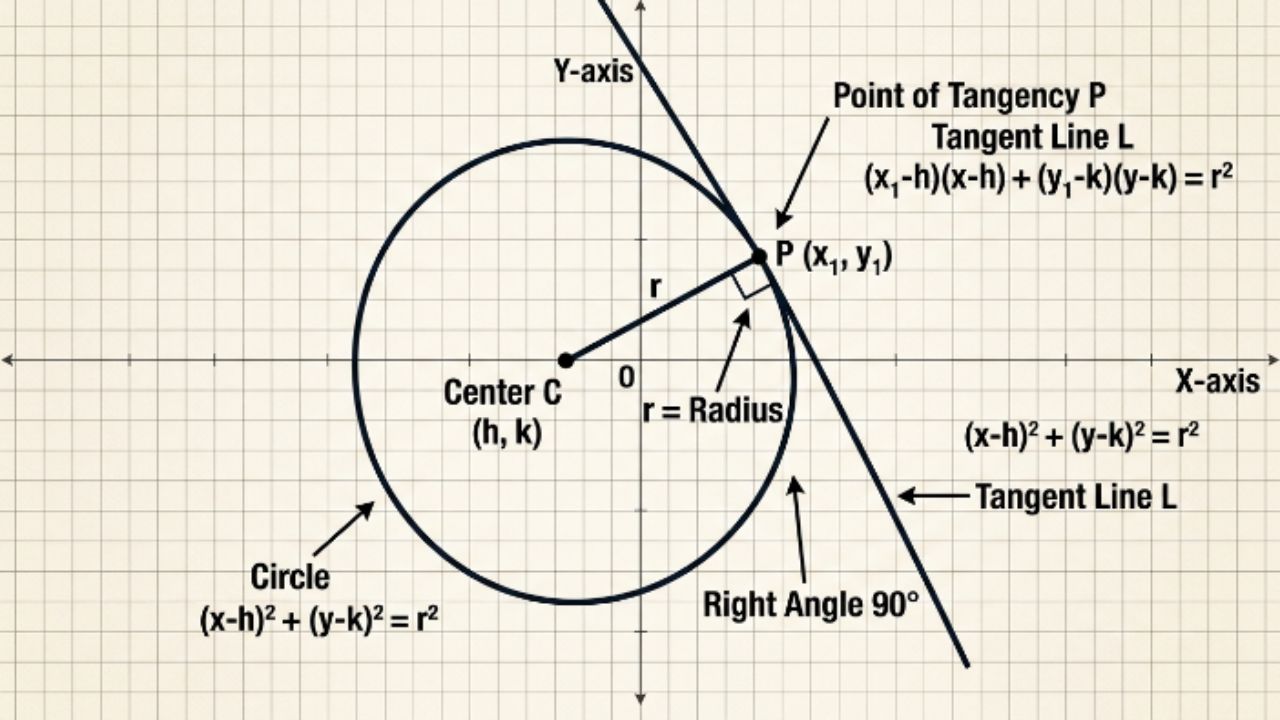
The relationship between the Line Tangent to Circle and the trigonometric tangent often confuses beginners because both use the same word.
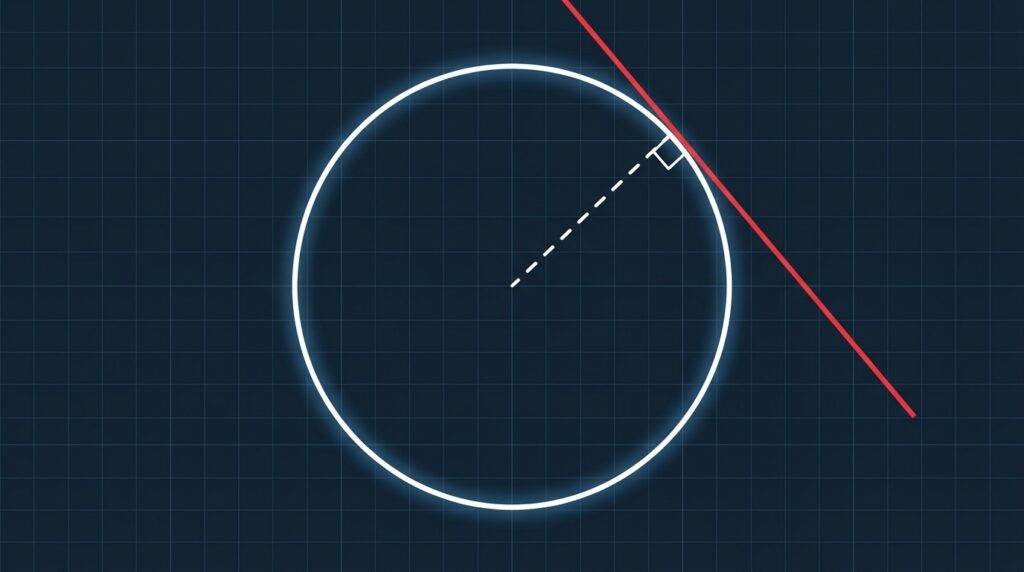
A Tangent Line in geometry touches the circle at exactly one point without cutting through it. Meanwhile, the trigonometric tangent measures a ratio.
They’re connected more than they first appear.
Imagine drawing the Unit Circle centered at the origin. Now draw a vertical Tangent Line touching the Point (1,0). Extend a ray from the origin at angle Theta (θ) until it meets this tangent line.
The distance along that tangent line equals tan θ.
That visual interpretation is beautiful in a quiet sort of way. The circle isn’t merely sitting there—it begins stretching information outward.
This idea links several important Mathematical Relationships:
- Geometry
- Coordinate Geometry
- Mathematical Functions
- Slope Interpretation
- Mathematical Visualization
Once you picture it, memorization becomes much less important.
Unit Circle Coordinates and Tangent Values
The Unit Circle Coordinates provide every important trigonometric value. Because Tangent (tan θ) equals sine divided by cosine, calculating tangent becomes almost automatic.
| Angle | Radians | Coordinates (x, y) | Tangent |
|---|---|---|---|
| 0° | 0 | (1,0) | 0 |
| 30° | π/6 | (√3/2, 1/2) | √3/3 |
| 45° | π/4 | (√2/2, √2/2) | 1 |
| 60° | π/3 | (1/2, √3/2) | √3 |
| 90° | π/2 | (0,1) | Undefined |
These are among the most common unit circle values, unit circle angles, and tangent values you’ll encounter.
Notice something curious.
As cosine gets closer to zero, tangent becomes incredibly large. It’s almost as though the graph starts sprinting toward infinity before anyone can stop it.
Why Is Tangent Undefined at 90 Degrees?
This question appears almost everywhere:
Why is tangent undefined at 90 degrees?
Let’s see.
At 90 Degrees, the coordinate becomes:
[
(0,1)
]
Now substitute into the tangent formula.
[
\tan(\theta)=\frac{1}{0}
]
Division by zero is impossible.
Because of that,
- Undefined Value
- Not a real number
- Does not equal Positive Infinity
- Does not equal Negative Infinity
Instead, mathematicians simply call it Undefined.
As the angle approaches π/2, the tangent grows larger and larger until it resembles an Infinite Slope or Vertical Slope.
That’s exactly why the Tangent Graph contains vertical asymptotes.
It looked strange to me the first time, honestly, but after seeing the coordinate explanation it made perfect sense.
How to Find Tangent on the Unit Circle Step by Step
Finding tangent becomes almost routine after practicing several times.
Step 1
Locate the angle.
Determine whether the angle is given in Degrees or Radians.
Step 2
Find the corresponding Coordinate Point on the Unit Circle.
Step 3
Identify:
- Cosine = x-coordinate
- Sine = y-coordinate
Step 4
Apply the Tangent Formula.
[
\tan=\frac{\sin}{\cos}
]
Example 1
Find tangent at 45 Degrees.
Coordinates:
[
(\sqrt2/2,\sqrt2/2)
]
Therefore,
[
\tan=\frac{\sqrt2/2}{\sqrt2/2}=1
]
Example 2
Find tangent at 60 Degrees.
Coordinates:
[
(1/2,\sqrt3/2)
]
Therefore,
[
\tan=\sqrt3
]
Example 3
Find tangent at 90 Degrees.
Coordinates:
[
(0,1)
]
Since
[
1/0
]
is impossible,
the tangent is undefined.
See? Nothing spooky happening there, just arithmetic refusing to cooperate.
Unit Circle With Tangent Examples
Let’s solve a few practical problems that often appear in homework and exams.
Example: Find tan(30°)
Sine:
[
1/2
]
Cosine:
[
\sqrt3/2
]
Answer:
[
\tan30^\circ=\frac{1}{\sqrt3}=\frac{\sqrt3}{3}
]
Example: Find tan(135°)
Coordinates:
[
(-\sqrt2/2,\sqrt2/2)
]
Therefore,
[
\tan135^\circ=-1
]
Example: Find tan(225°)
Coordinates:
[
(-\sqrt2/2,-\sqrt2/2)
]
Answer:
[
\tan225^\circ=1
]
Notice how signs change depending upon the Quadrants.
That little detail catches lots of students, me included once or twice if I’m being fair.
Relationship Between Sine, Cosine, and Tangent
The three main Trigonometric Functions are deeply connected.
Think of them almost like siblings who argue but secretly depend on each other.
- Sine Function measures vertical movement.
- Cosine Function measures horizontal movement.
- Tangent Function compares the two.
This creates the famous Trigonometric Ratios used throughout mathematics.
Important identities include:
[
\tan(\theta)=\frac{\sin(\theta)}{\cos(\theta)}
]
and
[
\sin^2(\theta)+\cos^2(\theta)=1
]
These Trigonometric Identities appear repeatedly in algebra, calculus, engineering, architecture, navigation, and physics.
The Role of Quadrants in Tangent
Understanding Quadrants helps predict whether tangent will be positive or negative before doing any calculations.
| Quadrant | Tangent |
|---|---|
| I | Positive |
| II | Negative |
| III | Positive |
| IV | Negative |
A tiny memory trick says:
“Positive, Negative, Positive, Negative.”
Its simple, maybe overly simple, but it sticks in the mind rather well.
Unit Circle Formula and Circle Equation
Every Unit Circle follows the Circle Equation:
[
x^2+y^2=1
]
This comes directly from the Distance Formula.
Distance from the center:
[
\sqrt{x^2+y^2}=1
]
Squaring both sides gives:
[
x^2+y^2=1
]
That equation connects Coordinate Geometry, Geometry Concepts, and Mathematical Modeling all at once.
It quietly proves why every coordinate sits exactly one unit from the center.
Common Mistakes Students Make
Learning understanding unit circle ideas becomes easier when you avoid these common errors.
- Forgetting that Radians and Degrees are different.
- Mixing up sine and cosine coordinates.
- Dividing cosine by sine instead of sine by cosine.
- Forgetting tangent becomes undefined whenever cosine equals zero.
- Using the wrong Reference Angle.
- Ignoring signs in different Quadrants.
- Confusing the geometric Tangent Line with the Tangent Trigonometric Function.
Honestly, nearly everyone slips on at least one of these at some point, so dont let it discourage you.
Real-Life Applications of the Unit Circle and Tangent
The Unit Circle in Trigonometry isn’t just classroom decoration.
It quietly supports countless real-world systems.
Engineers use Trigonometric Calculations when designing bridges and buildings.
Computer graphics rely on Angle Rotation, Coordinate System mathematics, and Mathematical Visualization to rotate objects realistically.
Pilots calculate directions using Angle Measurement.
Surveyors measure land with Coordinate Geometry Examples.
Game developers use Function Behavior, Coordinate Graph, and Circle Mathematics every single day.
Even robotics uses Mathematical Reasoning to determine movement and positioning.
One mathematics professor once joked, “The unit circle keeps showing up even when nobody invited it.” That sentence stayed with me because, strangely enough, it’s pretty true.
FAQ Practice Questions
Try solving these without immediately checking your notes.
- Find tan(45°).
- Find tan(60°).
- Why is tan(90°) undefined?
- Determine the coordinates for 30 Degrees.
- Explain the Slope of a Line represented by tangent.
- Identify the Reference Angle for 210°.
- Sketch a simple Coordinate Plane showing the Circle Center and the Point (1,0).
Working through these examples builds confidence much faster than simply rereading formulas.
Tips for Learning the Unit Circle Easily
If you’re wondering how does tangent work on the unit circle, slow practice beats rushed memorization every single time.
Draw the circle repeatedly instead of only staring at a printed unit circle chart or unit circle table. Label the x-axis, y-axis, Origin, and important special angles like 30 degrees, 45 degrees, 60 degrees, and 90 degrees. Say the coordinates aloud as you write them—it feels a bit odd at first, yet the repetition somehow settles them into memory.
Another trick is to connect every standard angle with its matching sine values, cosine values, and tangent values rather than treating each function separately. When you understand the relationship, the entire Trigonometric Circle becomes much easier to visualize.
What is the Unit Circle with Tangent?
The Unit Circle with Tangent shows how the tangent function is calculated using the unit circle. Tangent is found by dividing sine by cosine (tan θ = sin θ / cos θ).
How do you find tangent on the unit circle?
Locate the angle on the unit circle, identify its sine and cosine coordinates, then divide the sine value by the cosine value to get the tangent.
Why is tangent undefined at 90°?
At 90° (π/2), the cosine value is 0. Since dividing by zero is undefined, the tangent value is also undefined.
What is the tangent formula on the unit circle?
The tangent formula is tan θ = sin θ / cos θ. It represents the ratio of the y-coordinate to the x-coordinate of a point on the unit circle.
Why is the unit circle important in trigonometry?
The Unit Circle helps you understand sine, cosine, and tangent values for all angles, making trigonometry problems easier to solve and visualize.
read this blog:https://mynoval.com/8-inches-long-2/
Final Thoughts
The Unit Circle with Tangent is much more than a diagram used for exams. It is a bridge connecting Geometry, Algebra, Mathematical Functions, and Trigonometry into one beautifully organized system. Once you understand the relationship between Coordinates (x, y), Cosine (cos θ), Sine (sin θ), and Tangent (tan θ), many topics that once seemed confusing begin to feel almost obvious.
Learning it takes patience, sure, and maybe a few scribbled pages full of circles that aren’t perfectly round. Mine certainly werent. But every sketch, every solved problem, and every small “aha!” moment builds a stronger intuition. Before long, the Unit Circle, Tangent Ratio, Angle Relationships, and Trigonometric Functions stop feeling like isolated formulas and start working together as one connected picture.
Keep practicing, redraw the circle from memory, solve plenty of unit circle examples, and revisit the fundamentals whenever something feels fuzzy. Mathematics often rewards curiosity more than speed, and the Unit Circle with Tangent is one of the best examples of that quiet truth.