

There is something strangely satisfying about turning a number into something the eyes can actually understand. 300 feet looks rather innocent on paper, but stand at one end of that distance and suddenly the number feels much bigger. I first thought about this kind of distance visualization while watching a family welcome a baby girl; everyone was measuring the room, moving chairs, making space for this tiny new person who somehow seemed to change the whole scale of the house. It reminded me that numbers only become meaningful when we connect them with real life, and 300 feet works much the same way.
So, how long is 300 feet? The quick answer is 100 yards, or about 91.44 meters. But that conversion alone doesn’t tell you what 300 feet actually looks like. A better way is to compare it with football fields, famous towers, giant trees, airplanes, whales, and landmarks. Once you start doing that, this simple unit of measurement becomes surprisingly easy to picture.
How Long Is 300 Feet in Simple Terms?
300 feet equals exactly 100 yards. Since one yard contains three feet, the calculation is wonderfully straightforward: 300 ÷ 3 = 100. In imperial measurement, feet and yards are commonly used for describing distances, heights, property dimensions, sports fields, and many everyday measurements.
In meters, 300 feet is 91.44 meters. So if you’re more familiar with metric units, imagine walking almost 91 and a half meters in a straight line. That’s not a tiny stroll, obviously, but it isn’t an enormous journey either.
Here is the basic conversion at a glance:
| Measurement | Equivalent |
|---|---|
| 300 feet | 300 ft |
| 300 feet | 100 yards |
| 300 feet | 91.44 meters |
| 300 feet | 0.09144 kilometers |
| 300 feet | 3,600 inches |
The interesting part isn’t really the arithmetic. It’s the real-world size hiding behind the arithmetic. A measurement becomes much easier to understand when your brain has something familiar to compare against.
How Far Is 300 Feet Visually?
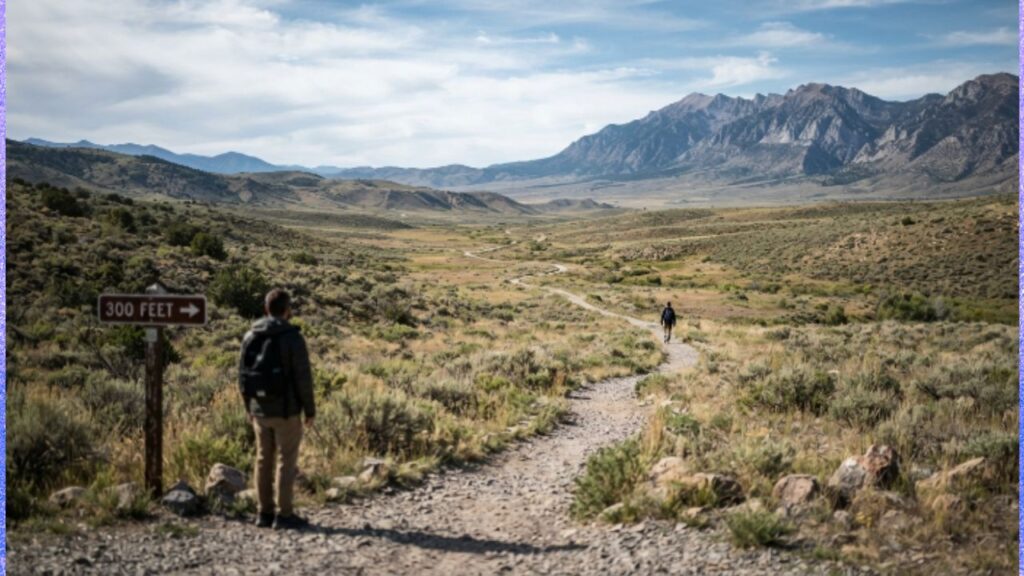
If you are standing at one end of a 300-foot stretch, the opposite end can feel farther away than you might expect. Trees, buildings, people and other objects between you and the destination can make the distance appear shorter or longer depending on the surroundings.
A straight, empty path makes 300 feet look remarkably clear. In a crowded neighborhood, however, your visual perception may struggle to judge it. This is because human distance perception isn’t a perfect measuring instrument. The brain uses familiar objects, angles, shadows, movement and context to estimate scale.
A rough walking comparison is useful too. Depending on your pace, walking 300 feet may take around 45 to 70 seconds. Someone walking briskly gets there sooner, while someone strolling slowly takes a bit longer. That makes 300 feet a nice example of time-based measurement and effort-based measurement working together.
Think of it as a distance you could walk without needing a proper rest, but long enough that you’d notice it.
300 Feet Compared With a Football Field
One of the easiest ways to visualize 300 feet is through sports.
A standard American football field, including its end zones, measures 360 feet from end line to end line. That means 300 feet is about 83.3% of an NFL football field.
Imagine standing on one end of an NFL field and walking toward the other. You would cover most of the field before reaching 300 feet, leaving about 60 feet still behind you. That’s a surprisingly powerful size comparison because many people have seen a football field, even if they have never consciously measured one.
A football field without the end zones is 300 feet long. So in that specific sense, the playing field itself gives you an almost perfect mental picture of the distance. Pretty neat, honestly.
300 Feet Compared With a Soccer Pitch
A Football (Soccer) Pitch can vary in dimensions depending on the venue and governing rules, but a commonly referenced full-length pitch is around 344 feet long.
That makes 300 feet somewhat shorter than a full soccer pitch. If you stood at one goal line and looked toward the other, 300 feet would take you most of the way there, with roughly another 44 feet remaining on a 344-foot example.
This is why sports fields are so helpful for distance measurement. Their boundaries create a visual frame that our brains understand almost instantly. Instead of thinking, “91.44 meters,” you can think, “nearly the length of a soccer pitch.”
And suddenly the number stops being mysterious.
How Tall Is 300 Feet?
Now things get more interesting because 300 feet can describe either horizontal length or vertical height.
If a building were 300 feet tall, it would tower over most ordinary houses and many smaller commercial structures. Looking upward from the sidewalk, you would need to tilt your head considerably to see the top, especially if the building stood close to you.
A 300-foot structure isn’t quite a skyscraper in the modern sense, but it is certainly a substantial building or tower. The experience of height is also affected by perspective. A 300-foot tower viewed from far away may look surprisingly small, while the same structure viewed from directly beneath it can feel enormous.
This is where spatial perception gets funny. Our eyes don’t come with a built-in ruler.
300 Feet Compared With the Statue of Liberty
The Statue of Liberty, formally called Liberty Enlightening the World, provides one of the closest famous comparisons.
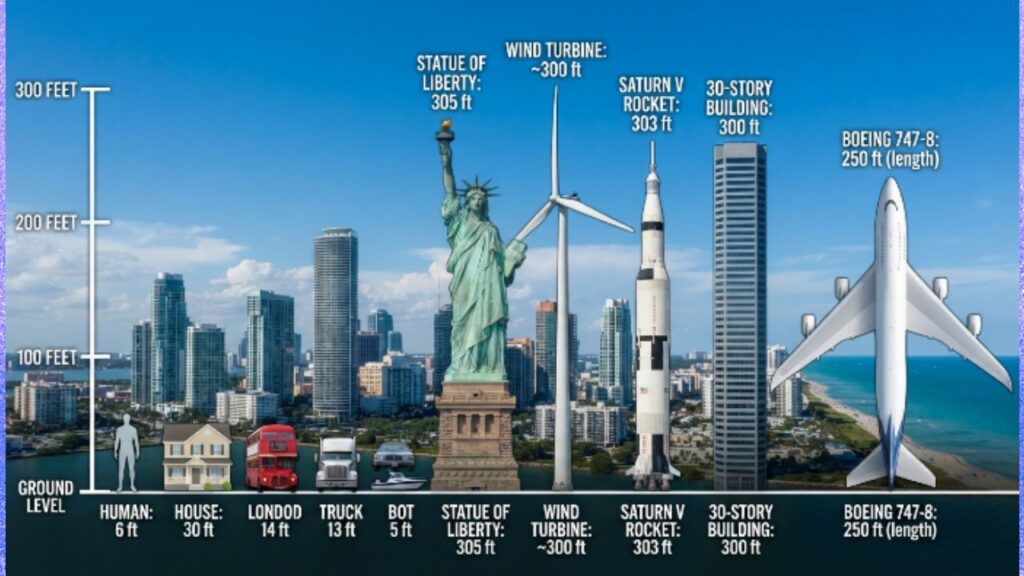
From the ground to the tip of the torch, the Statue of Liberty stands approximately 305.10 feet tall. So 300 feet is only about 5 feet shorter than the entire height of the monument from its foundation to torch.
That’s an excellent answer to anyone wondering what does 300 feet look like. Imagine almost the complete vertical height of the Statue of Liberty.
The monument stands on Liberty Island, where its surroundings give visitors plenty of visual context. When you see photographs of the statue beside people, boats, and buildings, your brain gets a better sense of its actual scale.
Three hundred feet is therefore not merely “quite tall.” It is almost Statue-of-Liberty-tall.
300 Feet Compared With Big Ben
Another useful comparison is Big Ben, the famous clock associated with the Clock Tower, London.
The tower is approximately 310 feet tall. That puts it just 10 feet above 300 feet, making it another remarkably close landmark comparison.
Imagine slicing the top 10 feet from Big Ben. What remains would be roughly 300 feet tall.
This comparison also demonstrates how architectural scaling changes our perception. A tower may appear smaller in a photograph because the surrounding buildings, streets and sky provide a huge visual frame. Stand nearby, though, and the same structure can suddenly feel almost absurdly tall.
300 Feet Compared With the Leaning Tower of Pisa
The Leaning Tower of Pisa is around 185 feet tall, depending on how its height is measured. That means 300 feet is considerably taller—about 115 feet more.
If you stacked the height of the Leaning Tower and then imagined another 115 feet above it, you’d get close to 300 feet.
The tower is famous partly because its unusual tilt changes our visual expectations. Straight structures are easy for the brain to judge, while tilted architecture can introduce a little perspective distortion.
That’s a reminder that visual measurements are not always as simple as they appear. An object can have a known mathematical height while still looking completely different depending on its angle and surroundings.
300 Feet Compared With a Giant Sequoia
Nature gives us another fantastic comparison.
A mature Giant Sequoia can reach around 250 feet in height, although individual trees vary. Compared with that, 300 feet is roughly 50 feet taller.
Picture a Giant Sequoia standing proudly in the Sierra Nevada, then imagine another 50 feet above its top. That’s approximately the scale we’re discussing.
Trees are especially useful for understanding 300-foot height because they make the measurement feel alive. A 300-foot tower is engineered upward; a giant tree reaches that scale through decades or centuries of growth. The number stays the same, but the story behind the height is completely different.
300 Feet Compared With a Boeing 747
A Boeing 747, sometimes nicknamed the “Queen of the Skies,” gives us a horizontal comparison rather than a vertical one.
Its wingspan is around 225 feet, depending on the specific 747 variant. Therefore, 300 feet is about 75 feet longer than the wingspan of a Boeing 747.
Imagine placing the aircraft’s wingspan on the ground and then adding another 75 feet. You’d be approaching 300 feet.
This is a great example of why length equivalent matters. A 225-foot wingspan and a 300-foot distance are both large measurements, but seeing the aircraft itself gives the brain something tangible to hold onto.
300 Feet Compared With Cinderella Castle
Cinderella Castle at Disney World is approximately 189 feet tall.
That means 300 feet is about 111 feet taller than the famous castle.
If you picture Cinderella Castle standing upright and then imagine extending its height by more than half another castle, you begin to approach 300 feet. It sounds slightly ridiculous when phrased like that, but mental comparisons sometimes need a little silliness to stick.
The castle is also a nice reminder that proportional design affects our perception. Turrets, roofs, windows and decorative details can make a building appear taller than its measured height.
300 Feet Compared With Nelson’s Column
Nelson’s Column, honoring Horatio Nelson, is approximately 169.40 feet tall.
At 300 feet, you could imagine placing the column’s height almost twice over, although not quite. Two Nelson’s Columns would total around 338.8 feet.
That makes 300 feet roughly 1.77 times the height of the monument.
This sort of comparison is useful because doubling a familiar object is often easier for the brain than imagining an isolated number. Once you’ve got one landmark in your mental picture, you can manipulate it like a ruler made from architecture.
300 Feet Compared With the Great Pyramid of Giza
The Great Pyramid of Giza presents an interesting twist.
Its original height was approximately 481 feet, although erosion and the loss of its outer casing reduced its present height to roughly 455 feet. Either way, 300 feet is substantially shorter than the pyramid.
Using the original 430-foot figure sometimes cited in simplified comparisons, 300 feet would be about 70% of that height.
The pyramid is a fascinating example of how architectural height can dominate the landscape. A 300-foot structure is huge, yet beside one of the great pyramids, it can suddenly seem modest. Scale is always relative, and that is one of the strangest tricks of human perception.
300 Feet Compared With the Spring Temple Buddha
The Spring Temple Buddha in China is dramatically taller than 300 feet. The statue itself is commonly listed at around 502 feet, depending on what portions of the monument are included in the measurement.
So 300 feet would be well over half its height.
The comparison demonstrates how quickly our sense of scale can break down when measurements reach hundreds of feet. We are accustomed to thinking in terms of rooms, houses, cars and streets. Hundreds of feet are outside the everyday range for most people, which is why famous landmarks are so useful.
300 Feet Compared With the Mahabodhi Temple
The Mahabodhi Temple in Bodh Gaya is often listed at approximately 180 feet high.
That means 300 feet is about 120 feet taller than the temple’s approximate height.
If you imagined the temple’s height and then added another two-thirds of that height, you’d be getting surprisingly close to 300 feet. Again, the point isn’t to create a perfect visual ruler; it’s to give your brain a useful real-world comparison.
Cultural landmarks can be particularly powerful in this way because their architecture is tied to stories, history, travel and human memory.
300 Feet Compared With the Blackpool Tower
The Blackpool Tower reaches approximately 518 feet in total height, making it much taller than 300 feet.
A 300-foot height would be somewhat more than half the tower’s full height. If you could visually remove the upper section of the tower, the remaining structure would give you a rough impression of 300 feet.
This comparison shows why “how tall is 300 feet?” doesn’t have one emotional answer. Beside a small building, 300 feet seems gigantic. Beside a 500-foot tower, it seems much less intimidating.
What Does 300 Feet Look Like in Everyday Life?
You don’t need famous monuments to understand this measurement.
Here are some everyday ways to think about 300 feet in real life:
- A straight playing field without end zones can be around 300 feet long.
- It is 100 yards, a very familiar sports measurement.
- It is about 91.44 meters, or nearly the length of a city block in some places.
- It can represent a noticeable walking distance across a park or open area.
- It is roughly the distance you’d cover walking for about a minute, depending on your pace.
- A 300-foot building would be dramatically taller than a typical house.
- A 300-foot line could stretch across a large open parking area.
- It is long enough to make a person at the opposite end look quite small.
- In a clear open space, it gives a useful example of visual distance.
- It can be imagined as a little more than four Boeing 747 wingspans placed end to end, though actual aircraft dimensions vary.
These aren’t precision surveying methods, of course. They’re mental shortcuts, and that is exactly what makes them useful.
Why 300 Feet Can Look Different Depending on Perspective
Have you ever looked down a long road and thought it was short, only to discover that it took several minutes to reach the other side? That’s perception doing its slightly mischievous thing.
Objects closer to you appear larger, while distant objects become visually compressed. Trees, people and buildings provide clues that help the brain estimate distance. Remove those clues, and distance perception becomes harder.
A phenomenon called forced perspective deliberately uses this fact. Designers arrange objects at different distances so they appear closer, farther, larger or smaller than they really are. Film sets, theme parks and architectural spaces have used versions of this technique for years.
An optical illusion can therefore make 300 feet appear shorter or longer without changing a single inch of the actual measurement.
Why Famous Comparisons Make Measurements Easier
Numbers are abstract. Landmarks aren’t.
If someone tells you a tower is 300 feet tall, your brain may respond with a polite little shrug. But if they say, “It’s almost as tall as the Statue of Liberty,” suddenly you’ve got a picture.
This is the heart of distance visualization. We translate an unfamiliar measurement entity into something stored in memory.
The same trick works with sports fields, trees, aircraft and animals. A blue whale, for instance, can reach lengths far beyond 300 feet? No—it doesn’t. That’s actually useful because it shows why checking comparisons matters. A blue whale is generally around 80 to 100 feet long, so 300 feet would equal roughly three large blue whales placed nose-to-tail.
That kind of comparison is much easier to imagine than “91.44 meters,” even if the image in your head is slightly silly.
300 Feet and the Famous Pebble Beach 17th Hole
Golf offers another interesting comparison through the Pebble Beach Golf Links.
The famous 17th Hole is a par-three hole that has been measured around 200 yards in some configurations and has a rich history associated with major events, including the 1972 U.S. Open. Golfers such as Jack Nicklaus helped make the course part of sporting history.
A 300-foot distance equals only 100 yards, so it is shorter than the full length of that hole. Still, imagining a golf shot or fairway segment of 100 yards gives another practical mental reference.
Golf is almost built around distance estimation, which makes it a natural world for understanding scale, angles and visual judgment.
How to Estimate 300 Feet Without a Measuring Tool
If you’re outdoors and need a rough estimate, don’t try to stare at the distance and magically know the answer. Use references.
Start by finding something familiar. A typical adult walking stride might be around 2.5 to 3 feet, although it varies greatly. You could therefore estimate the distance through repeated steps, but this is only an approximation and becomes less reliable as terrain changes.
Another method is to use known field dimensions, road markings, building lengths or mapped distances. If you’re doing anything where accuracy matters construction, property boundaries, safety work or surveying use proper equipment rather than eyeballing it.
Your eyes are excellent at recognizing faces. They are not secretly licensed surveyors.
A Quick 300-Feet Comparison Table
| Object or Landmark | Approximate Size | How It Compares With 300 Feet |
|---|---|---|
| 300 feet | 300 ft | Exact reference |
| 100 yards | 300 ft | Exact equivalent |
| Statue of Liberty | 305.10 ft | Almost the same height |
| Big Ben | 310 ft | About 10 ft taller |
| Soccer pitch example | 344 ft | Somewhat longer |
| NFL field | 360 ft | 60 ft longer |
| Giant Sequoia | 250 ft | About 50 ft shorter |
| Boeing 747 wingspan | 225 ft | About 75 ft shorter |
| Cinderella Castle | 189 ft | About 111 ft shorter |
| Leaning Tower of Pisa | 185 ft | About 115 ft shorter |
| Nelson’s Column | 169.40 ft | About 130.60 ft shorter |
| Great Pyramid of Giza | ~430 ft in simplified historical comparisons | About 130 ft taller |
| Spring Temple Buddha | 502 ft | Much taller |
| Mahabodhi Temple | 180 ft | About 120 ft shorter |
| Blackpool Tower | 518 ft | Much taller |
The figures above are useful for measurement comparison, but landmark dimensions can differ depending on exactly what part of a structure is included. That’s an important little detail people often forget when comparing heights.
Is 300 Feet a Long Distance?

Yes, but the answer depends on what you’re comparing it to.
For a person walking, 300 feet is a meaningful distance but not an exhausting journey. For a building, 300 feet is very tall. For a football playing field, it is exactly the length between the goal lines excluding the end zones. For an airplane, 300 feet is only a little longer than the wingspan of a large Boeing 747.
That contrast is the entire lesson.
Length and distance are contextual. The same 300-foot measurement can feel tiny in one setting and enormous in another. A golfer may think of it as a moderate target, an architect may think of it as a substantial height, and someone crossing a park may simply think, “Why is that bench so far away?”
FAQ 300 Feet
How Long Is 300 Feet?
300 feet is equal to 100 yards or 91.44 meters, making it a substantial everyday distance.
How Far Is 300 Feet Visually?
300 feet looks roughly like the length of a football field without the end zones, giving you an easy visual reference.
How Tall Is 300 Feet?
A 300-foot height is nearly as tall as the Statue of Liberty, which is about 305 feet from ground to torch.
How Many Yards Are in 300 Feet?
There are exactly 100 yards in 300 feet, because one yard equals three feet.
What Does 300 Feet Look Like in Real Life?
You can visualize 300 feet as a 100-yard stretch, most of an NFL football field, or nearly the height of the Statue of Liberty.
What Is 300 Feet Tall?
300 feet is nearly the height of the Statue of Liberty, which stands about 305 feet from the ground to the torch.
300 Feet Visually
Visually, 300 feet is about 100 yards roughly the length of an American football field excluding the end zones.
Read This Blog:https://mynoval.com/celsius-to-fahrenheit/
Final Thoughts: Making 300 Feet Feel Real
So, how long is 300 feet?
It is 300 ft, 100 yards, or 91.44 meters. More importantly, it is nearly the height of the Statue of Liberty, slightly shorter than Big Ben, about five-sixths of an NFL football field, longer than a Giant Sequoia is tall, and about 75 feet longer than a Boeing 747’s wingspan.
But perhaps the best way to remember it is simpler: picture a 100-yard stretch of open ground. Stand at one end, look toward the other, and imagine walking across it. That’s 300 feet.
And just as a family can welcome a tiny baby girl and somehow make an entire home feel emotionally bigger, measurements can do something similar to our minds. A number that once looked flat and ordinary suddenly gains shape, distance and personality when we connect it with the world around us.
That’s the little magic of real-world measurement. We don’t really understand scale until we can see ourselves somewhere inside it.
If you’re trying to picture 300 feet visually, don’t memorize the number alone. Compare it with a football field, a landmark, a giant tree, an airplane, or the distance you can walk in about a minute. Your brain will remember the picture much longer than it remembers 91.44.
And next time somebody asks, “How far is 300 feet?” you won’t need to stare at the ceiling like the answer is hiding up there. You’ll have a whole collection of landmarks, fields and wonderfully oversized mental rulers ready to go.