

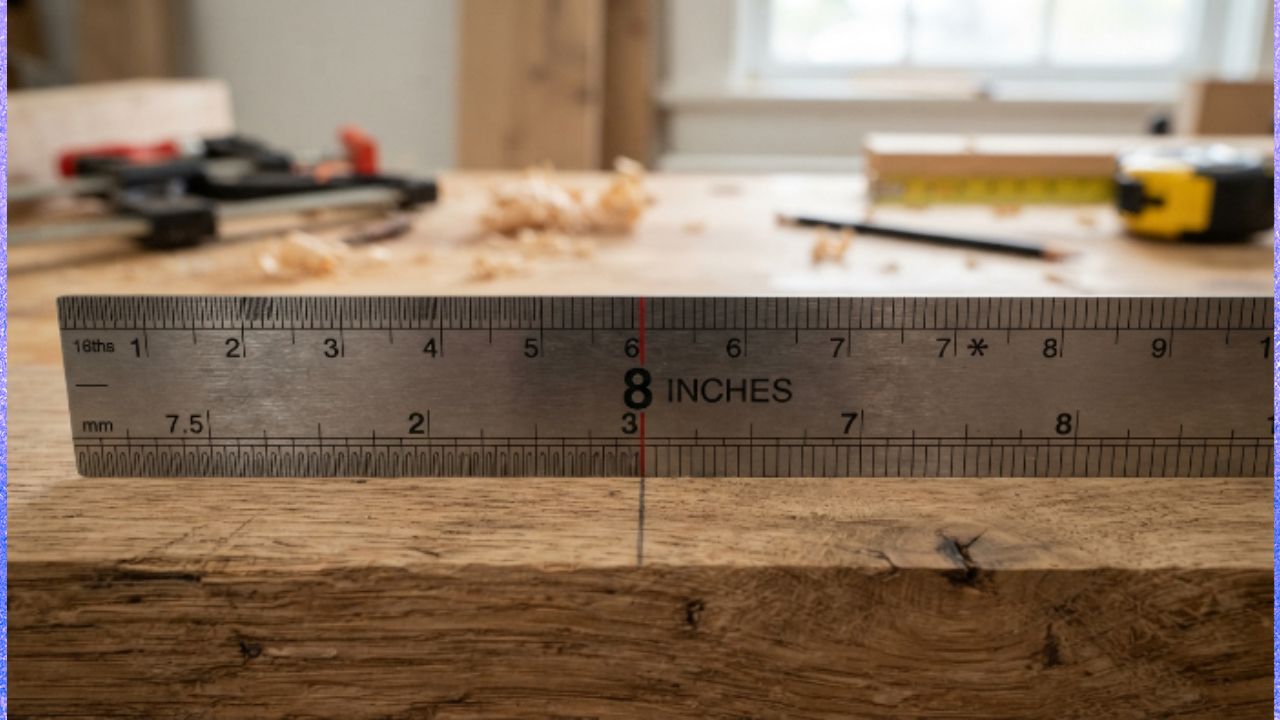
Have you ever looked at a measurement and thought, “Okay… but what does that actually look like?” 8 inches is one of those lengths that sounds perfectly clear on paper and somehow becomes a little slippery in real life. You can read the number, nod knowingly, and still have no real picture of it in your head. Happens to pretty much everyone.
That is why everyday objects are such useful little measuring friends. Instead of staring at a ruler, you can compare 8 inches with a familiar book, a kitchen tool, a small electronic device, or even part of your hand. Suddenly, the number stops being an abstract measurement and starts becoming something you can almost hold in your imagination.
In this guide, we’ll explore 15 common things that are 8 inches long or very close to that size. Some are surprisingly obvious, while others might make you pause and say, “Wait, really?” The goal isn’t merely to collect objects, but to build better size awareness, understand object dimensions, and make visual measurement a bit easier.
How Big Is 8 Inches?
Before jumping into examples, let’s pin down exactly what we’re talking about. 8 inches equals 20.32 centimeters, 0.67 feet, 0.203 meters, or 203.2 millimeters. So when someone asks, “How long is 8 inches?” the answer is about 20 centimeters, which is roughly two-thirds of a foot.
An inch is a unit of length used heavily in the imperial measurement system, particularly in the United States. Eight of those inches lined up together create a length that is neither tiny nor especially large. It sits in that useful middle zone where lots of ordinary objects happen to land.
| Measurement | Equivalent |
|---|---|
| 8 inches | 20.32 centimeters |
| 8 inches | 0.67 feet |
| 8 inches | 0.203 meters |
| 8 inches | 203.2 millimeters |
| 8 inches | About two-thirds of a foot |
That conversion table gives you the mathematical answer, sure, but numbers alone don’t always help with size perception. For that, familiar objects are much better.
1. An 8-Inch Chef’s Knife
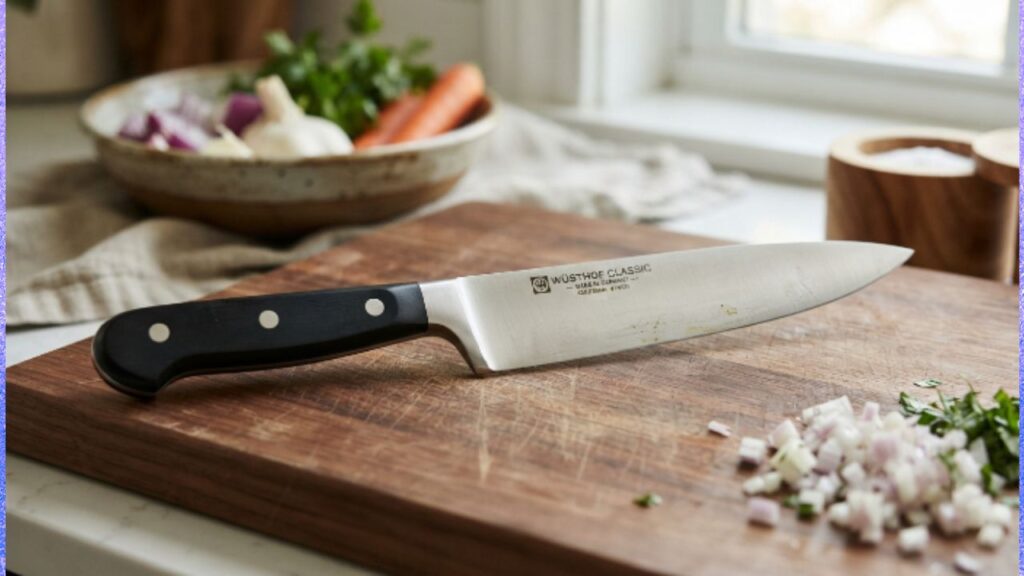
An 8-inch chef’s knife is probably one of the most useful examples of an object that naturally matches this measurement. Many standard chef’s knives have blades around eight inches long, making them a handy reference when you’re trying to picture the distance.
The interesting bit is that the eight-inch measurement usually refers to the blade rather than the entire knife. Add the handle and the whole thing becomes considerably longer. So if you’re visualizing 8 inches, imagine only the cutting portion stretching from the tip toward the handle.
In a busy kitchen, an eight-inch chef’s knife can look fairly substantial without being enormous. It’s large enough for chopping vegetables, slicing meat, and handling everyday cooking tasks, but still manageable for many home cooks.
2. A Small Tablet or iPad Mini-Style Device
A compact tablet is another useful visual reference, though there’s an important detail: tablet screen measurements are normally measured diagonally, not straight across.
An iPad Mini, for example, has a display around eight inches diagonally, depending on the specific model. That means its screen gives you a very recognizable sense of what an 8-inch object can look like in the real world.
If you’ve held a small tablet device before, you already have a pretty good mental ruler hiding somewhere in your memory. It feels bigger than a smartphone, but much smaller than a typical laptop. That middle size makes compact tablets popular for reading, browsing, note-taking, and casual entertainment.
3. A Standard Dinner Fork
A typical dinner fork can measure close to eight inches from end to end, although the exact length varies by design and manufacturer. Some forks are shorter, some are longer, so think of this as an approximate example rather than a laboratory-certified measurement.
Place a fork on a table and look at its full length. Suddenly, 8 inches visually becomes much easier to understand. The handle adds most of the length, while the tines occupy only a small section at the top.
It’s also a nice example because almost everyone has seen a dinner fork. You don’t need special equipment, technical knowledge, or a fancy gadget to use it as a measurement reference.
4. A Large Smartphone, Such as an iPhone 7-Size Device
A smartphone can help explain eight inches, but there’s a catch that people sometimes miss. The iPhone 7, for instance, is much shorter than eight inches in its overall height, so it shouldn’t be described as an eight-inch-long phone.
Still, putting several familiar smartphones side by side helps develop size comparison skills. A phone is generally much smaller than eight inches in length, while an eight-inch diagonal display belongs more naturally to a small tablet category.
This distinction matters because product measurements can refer to height, width, thickness, or screen diagonal. Same object, different measurement. Kinda sneaky, honestly.
5. A Small Pizza
Imagine an 8-inch pizza sitting in front of you, with cheese bubbling across the surface and that first slice somehow disappearing before you’ve even decided you’re hungry.
An eight-inch pizza measures about eight inches across its diameter. That makes it a very practical visual example of the measurement, though the actual amount of food depends on crust thickness, toppings, and how generously the pizza is made.
For portion control, an eight-inch pizza is also interesting because diameter doesn’t tell the whole story. A thicker pizza can contain much more food than a thin crust one of the same diameter. So even everyday measurements sometimes need a little context.
6. A Small Hardcover Book
Many compact hardcover books are somewhere around seven to nine inches in height, putting an eight-inch book right in the sweet spot for this comparison.
Grab a smaller novel, cookbook, or journal from a bookshelf and look at its vertical edge. If it comes close to eight inches, you’ve got an easy visual reference for 8 inches sitting right there.
Books are particularly helpful because their rectangular shape makes length easy to judge. You can hold one against your hand, compare it with a sheet of paper, or simply place it beside a ruler and build your internal mental ruler.
7. A Kitchen Spatula
A compact kitchen spatula can be approximately eight inches long, especially smaller silicone or turner-style utensils designed for frying pans and saucepans.
The length can vary a lot depending on whether you’re measuring the head, the handle, or the entire utensil. A full kitchen spatula around eight inches gives you another practical example of 8-inch household items.
Imagine one lying beside a frying pan. The comparison makes the measurement much more tangible than saying “20.32 centimeters.” Centimeters are precise, of course, but a spatula has a personality. Numbers don’t.
8. A Pencil Case
A small pencil case is another object that often comes surprisingly close to eight inches in length. Different cases are made for different collections of pens, markers, pencils, and other stationery, so sizes naturally vary.
An eight-inch pencil case is long enough to hold several writing tools while remaining compact enough to slip into a backpack. If you’re trying to estimate length without a ruler, your own pencil case could become a convenient household measuring reference.
Lay eight inches across the long side and you’ll begin to understand why this size works so well for desk essentials. It isn’t huge, but it offers enough room to be useful.
9. A Small Decorative Vase
Some small decorative vases stand around eight inches tall. Their shapes can be dramatically different, though, so don’t assume every vase is eight inches just because it looks similar.
A narrow vase eight inches high can feel quite tall on a shelf, while a wide vase at the same height may look much more substantial. This is a perfect example of how size perception depends on more than one dimension.
Height, width, depth, shape, and surrounding objects all influence how large something appears. That’s why visual measurement is useful, but it should be treated as an estimate unless exact dimensions matter.
10. A Candle Jar
A medium or large candle jar may approach eight inches in height or circumference, depending on its design. Again, this isn’t a universal measurement, but some decorative candle containers make excellent real-life comparisons.
Picture one standing on a table beside a book. If the candle is roughly eight inches tall, you’re looking at about 20.32 cm from its base to its top.
Candles also demonstrate why measurements should specify what direction they’re describing. An eight-inch height is completely different from an eight-inch diameter. Sounds obvious, but product descriptions can make this confusing real quick.
11. A Picture Frame
A 5×7 picture frame is smaller than eight inches on its longest internal dimension, but a larger compact picture frame may measure around eight inches along one side.
Frames are especially useful for understanding object dimensions because they’re clearly rectangular. You can immediately see the relationship between length and width without having to imagine a complicated shape.
If you have a frame at home that is close to eight inches across, place your hand next to it. That little comparison can help turn a technical 8-inch measurement comparison into something familiar.
12. A Mini Rolling Pin
A mini rolling pin used for small baking projects can measure close to eight inches long. These compact tools are handy for pastry, small batches, decorative dough work, and other bits of home cooking where a giant rolling pin feels like overkill.
The handles and barrel may differ depending on the design, so the overall length isn’t always exactly eight inches. But when you see one around that size, it gives you a strong physical sense of what eight inches looks like.
It’s also a good reminder that everyday objects don’t have to be exact to be useful for estimation. We’re building a visual reference, not launching a satellite.
13. A Compact Flashlight
Some compact flashlights designed for travel, camping, or emergency kits are around eight inches long. Larger handheld flashlights can obviously be much longer, while keychain models are tiny.
An eight-inch flashlight would fit comfortably into the category of portable outdoor tools and travel gear. You might find one in a camping bag, vehicle emergency kit, or utility drawer.
If you’re packing a backpack, an object around eight inches gives you a useful idea of how much horizontal space a moderately sized tool can occupy. It’s a small measurement, but in a crowded bag every inch starts acting like it owns the place.
14. A Small Art Canvas

Small art canvases and painting panels are frequently sold in dimensions around eight inches on one side. An 8×8-inch square canvas, for example, gives you exactly eight inches from one edge to the other.
For artists, this is an especially clear 8-inch size example because the dimensions are normally printed directly on the packaging.
An eight-inch square canvas also helps demonstrate the difference between length and area. One side is eight inches, but the surface isn’t “eight inches” total. Its area is 64 square inches. Tiny wording difference, very different measurement.
15. A Short Ruler or Folding Measurement Tool
Perhaps the most obvious example is a short ruler. While many common rulers measure 12 inches, shorter rulers and compact folding rulers can be around eight inches long.
This one is useful because a ruler turns the abstract idea of measurement into visible markings. Once you’ve seen eight inches marked out, you can begin comparing that distance against other objects around your home.
It also gives you a way to test your guesses. Estimate the length of a pencil case, spatula, book, or flashlight first, then check it. That little game is surprisingly effective for improving length estimation.
A Quick 8-Inch Size Comparison
Here’s a compact reference for the examples above. Remember that many everyday objects vary by brand, model, and design, so these should be treated as approximate comparisons rather than exact specifications.
| Object | Approximate 8-Inch Connection |
|---|---|
| Chef’s knife | Blade often around 8 inches |
| Compact tablet | Screen may be around 8 inches diagonally |
| Dinner fork | Often close to 8 inches overall |
| Small pizza | 8-inch diameter |
| Hardcover book | Some compact books near 8 inches tall |
| Kitchen spatula | Some models around 8 inches |
| Pencil case | Compact cases can approach 8 inches |
| Decorative vase | Some small vases around 8 inches tall |
| Candle jar | Some larger jars near 8 inches |
| Picture frame | Compact frames can have an 8-inch side |
| Mini rolling pin | Some models around 8 inches |
| Flashlight | Compact models may approach 8 inches |
| Art canvas | 8×8-inch canvases are common |
| Folding ruler | Some compact rulers are around 8 inches |
| Kitchen utensils | Various small tools can fall near 8 inches |
How to Visualize 8 Inches Without a Ruler
If a ruler isn’t nearby, don’t panic. Your hands can become a rough hand span reference, although everyone’s hands are different. The distance from the tip of your thumb to the tip of your little finger when your hand is stretched can provide a useful personal benchmark.
You can also use a sheet of standard paper as a reference. In the United States, letter-size paper is 11 inches on its longer side, so eight inches is noticeably shorter than the full length. It’s not exact enough for technical work, but for ordinary everyday measurements, it works pretty well.
Another trick is to remember the conversion: 8 inches is 20.32 centimeters. If you’ve handled a 20-centimeter ruler, you already have a fairly good physical sense of the distance.
8 Inches Compared to Your Hand
Hands are convenient because they’re always, well, attached to you. But using a hand as a measuring device has limitations. A person’s palm and finger lengths vary substantially, so one person’s hand span won’t necessarily match another person’s.
Still, if your hand span from thumb to little finger is close to eight inches, you’ve got a personalized measurement reference. Even if yours is shorter or longer, repeatedly comparing it with known objects can improve your size awareness over time.
The goal isn’t perfection. It’s to make the length recognizable enough that when somebody says “about eight inches,” your brain has somewhere sensible to put that information.
How to Measure 8 Inches Without a Ruler
There are a few easy measurement hacks that can help when you don’t have a ruler around.
First, use a known object. A standard sheet of letter paper is 11 inches long, so eight inches is roughly three inches shorter than its longest edge. That gives you a decent estimate.
Second, use a smartphone as a comparison object, but check your particular model first. Phones vary considerably in size, and guessing that every smartphone is a certain length can lead you badly astray.
Third, use your hand as a personal reference. Measure your hand once with a ruler when you have one available, then remember the approximate distance. Over time, this becomes a surprisingly useful mental ruler.
And finally, don’t confuse approximation with precision. If you’re cutting expensive material, installing hardware, or doing a technical project, use an actual measuring tool. Your hand is clever, but it doesn’t have calibration marks.
Why Everyday Objects Make Measurements Easier
There’s something oddly comforting about comparing numbers to things we already know. Saying “20.32 centimeters” is mathematically precise, but saying “about the length of a chef’s knife blade” instantly gives your brain a picture.
This is why things that are 8 inches long can be useful in education, shopping, DIY projects, cooking, crafting, and even simple conversations. Familiar objects give measurements a physical identity.
You start building a personal library of references: a foot is about the length of a large adult shoe, a meter is roughly a big stride, and eight inches sits somewhere around the length of certain kitchen tools, books, and compact objects.
That’s really what size awareness is about. Not memorizing endless conversions, but learning to recognize scale.
Things That Are 8 Inches: What to Remember
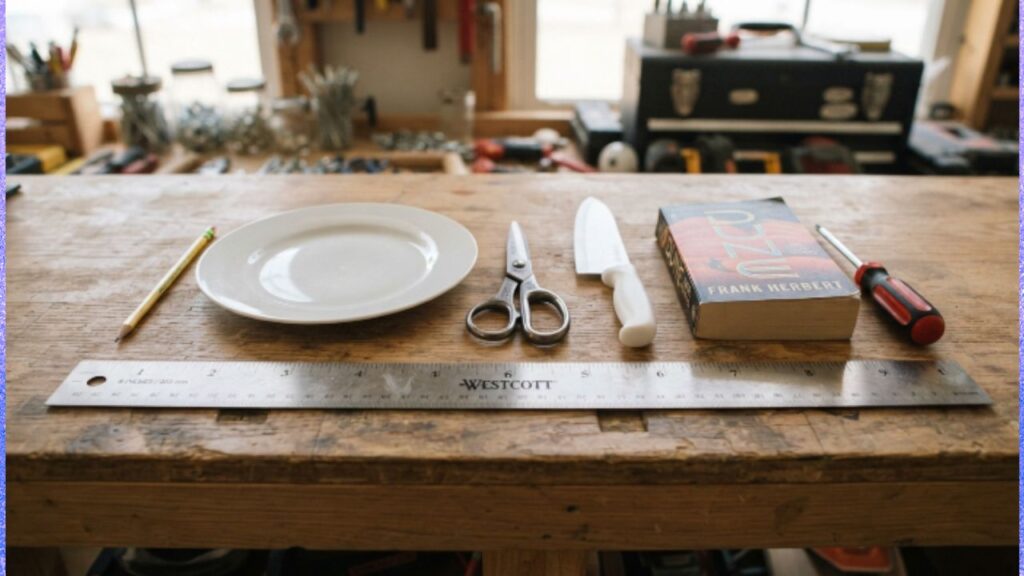
The most important thing to remember is that eight inches equals 20.32 centimeters. It is about 0.67 feet, or a little more than half a foot and less than a full foot.
When you need to imagine how big 8 inches is, think about an eight-inch pizza, a chef’s knife blade, a compact tablet display measured diagonally, a small art canvas, or another familiar object from the list.
Just don’t assume every similar-looking object has exactly the same dimensions. Manufacturers love making things slightly different. A pencil case from one company may be eight inches, while another might be seven and a half. That’s normal.
Frequently Asked Questions
What are some common things that are 8 inches long?
Common things that are 8 inches long include an 8-inch chef’s knife blade, small pizza, dinner fork, mini rolling pin, and some compact rulers.
How big is 8 inches?
8 inches equals 20.32 centimeters, 0.67 feet, 0.203 meters, or 203.2 millimeters. It’s roughly two-thirds of a foot.
What does 8 inches look like?
To visualize 8 inches, imagine the diameter of a small 8-inch pizza or the blade of a typical 8-inch chef’s knife. These provide useful real-life references.
How can I measure 8 inches without a ruler?
You can estimate 8 inches by comparing an object with your hand span, a familiar kitchen utensil, or another object whose dimensions you already know.
Is 8 inches the same as 20 centimeters?
Not exactly. 8 inches is 20.32 centimeters, so it is slightly longer than 20 centimeters by 0.32 cm.
8 Inch Length
An 8-inch length equals 20.32 centimeters, or about 0.67 feet. It’s roughly two-thirds the length of a foot.
How Much Is 8 Inches?
8 inches is 20.32 cm, 0.203 meters, or 203.2 millimeters. It’s a little more than 20 centimeters.
How Big Is 8″
8 inches is about the length of a typical 8-inch pizza diameter or an 8-inch chef’s knife blade, making these useful visual references.
Household Items That Are 8 Inches
Common household items around 8 inches include chef’s knife blades, dinner forks, small spatulas, pencil cases, mini rolling pins, and compact rulers.
How Long Is .8 Inches?
0.8 inches equals 2.032 centimeters or about 20.32 millimeters. It is one-tenth the length of 8 inches.
Read This Blog:https://mynoval.com/what-time-was-it-7-hours-ago-find-out-instantly/
Final Thoughts on Visualizing 8 Inches
Measurements become much less intimidating once they leave the page. 8 inches isn’t just a string of numbers; it’s a physical distance that shows up in kitchens, offices, backpacks, bookshelves, electronics, art supplies, and countless ordinary places.
The next time someone asks, “What is 8 inches long?”, you don’t have to stare blankly into the middle distance. Think of the examples we’ve explored. Picture a small pizza. Imagine a chef’s knife blade. Recall a compact book or an eight-inch canvas. Your brain will start assembling the distance for you.
And perhaps that’s the nicest thing about visualizing 8 inches: you don’t really need to memorize it. You just need a few familiar objects to anchor the idea.
Measurements are numbers, yes, but everyday life gives those numbers shape. Once you learn to see the shape, eight inches becomes a whole lot easier to understand.